
The 2026 Advanced Vacuum Components Industry Report notes that UHV applications are expanding into increasingly complex sectors — fusion, quantum computing, and advanced semiconductor fabrication. One consequence: components that used to live at room temperature now spend their lives cycling between 300 K and 4 K, sometimes daily.
For edge welded bellows, cryogenic service is a different world. The physics of fatigue, the behavior of materials, and even the meaning of “leak-tight” change when temperatures swing hundreds of kelvin. This guide walks through the engineering that matters.
What Changes at Cryogenic Temperature
1. Materials get stronger — and more brittle
Most austenitic stainless steels become stronger at cryogenic temperature, but some lose ductility. 316L retains excellent toughness down to 4 K and is the workhorse. AM350 in certain tempers can be used where higher strength is needed. Inconel alloys are chosen for their combination of strength, low thermal conductivity and fatigue resistance. The material guide has the full comparison.
2. Thermal contraction is real, and directional
Cooling from 300 K to 4 K shrinks stainless steel by about 0.3%. For a 200mm-long assembly that is 0.6mm of movement — easily absorbed by a bellows, but only if the design accounts for it. The bellows acts as a thermal expansion joint while maintaining the vacuum boundary.
3. Fatigue is driven by thermal cycling, not motion
In cryogenic service, the bellows often moves because of temperature change, cycling millions of times without any mechanical actuation. Fatigue design must consider thermal cycles as the primary duty — a different convolution geometry than a motion bellows.
4. Heat leak becomes a design constraint
In a cryostat, every watt of conducted heat costs money (and cooling power). Thin-wall bellows with long effective paths minimize conduction — but thinner walls reduce pressure capability. This trade-off is exactly what the design guide quantifies.
Specification Checklist for Cryogenic Bellows
- Temperature range: define 4 K, 77 K or 300 K service — it changes material and geometry choices.
- Cycle count: specify thermal cycles (e.g., 10,000) plus any mechanical cycles.
- Leak rate: 1×10⁻⁹ mbar·L/s helium, tested at both room temperature and cryogenic temperature where possible.
- Heat leak budget: maximum permitted conducted heat at the operating temperature.
- Pressure and stroke: internal/external pressure and required movement envelope.
- Cleanliness: vacuum-fired or ultrasonically cleaned, particle-free delivery.
Test Like It Will Be Used
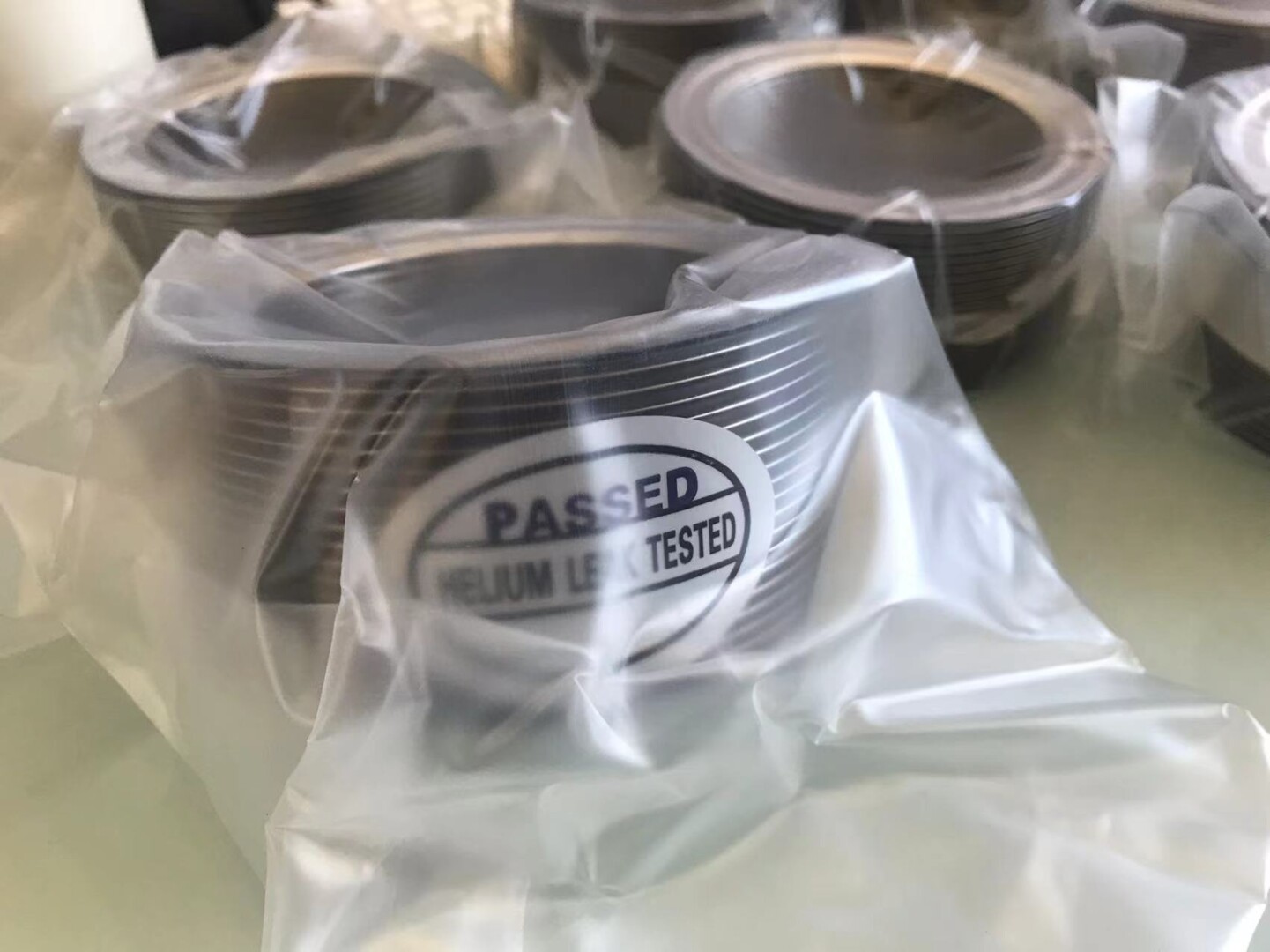
A bellows that passes a room-temperature helium test can still leak at 4 K if the design doesn’t manage differential contraction. Qualified suppliers test at temperature: helium leak testing with the assembly immersed in LN2 (77 K) is a practical proxy, and full 4 K testing is available for critical components. Alpha Technology provides cryogenic leak testing and thermal-cycle validation on request.
FAQ
Can standard room-temperature bellows be used at 4 K?
Not reliably. Materials, geometry and testing all need to be designed for cryogenic duty; a standard part may embrittle, leak, or conduct too much heat.
Which materials are best for cryogenic bellows?
316L for general service, AM350 for higher strength, Inconel 718 for the most demanding fatigue and heat-leak combinations.
How do you test a bellows for cryogenic service?
Helium leak testing at cryogenic temperature (e.g., immersed in LN2), thermal cycling validation, and fatigue testing on representative samples.
Does Alpha Technology make cryogenic-rated bellows?
Yes — custom edge welded bellows for quantum, fusion and space programs, with cryogenic leak testing and full documentation.
Need a bellows for a cryogenic system? Contact Alpha Technology with your temperature range, pressure and heat-leak budget.