
On August 3, 2026, Mordor Intelligence sized the sputtering equipment cathode market at $1.36 billion for 2026, growing to $1.79 billion by 2031 at a 5.62% CAGR. Wider estimates put total sputtering equipment revenue at $2.67 billion in 2025, heading toward $4.59 billion by 2034 at 6.2% CAGR. The demand drivers read like a list of modern industry: semiconductor metallization, optical coatings, architectural glass, hard tool coatings, solar cells and data-storage films.
What every one of those applications shares is the machine itself — and a magnetron sputtering system is, before anything else, a vacuum system. The plasma physics gets the attention, but the availability, yield and uptime of a sputtering tool are decided by its vacuum hardware: the seals, valves, feedthroughs and bellows that hold process pressure and move parts through the chamber.
How Magnetron Sputtering Works (and Why It Needs Vacuum)
In a sputtering system, a chamber is evacuated to a high vacuum base pressure — typically 10-6 mbar or better — and then backfilled with argon to a process pressure around 10-3 mbar. A negative voltage applied to the target material ionizes the argon; the ions accelerate into the target and knock atoms loose, which then condense as a thin film on the substrate. Magnetic fields behind the target trap electrons, intensifying the plasma — the “magnetron” in the name.
The two-step pressure requirement explains the hardware burden: the chamber must pump down fast to a very clean base pressure (residual water and oxygen ruin films), then hold a stable process pressure during coating. Between those states, substrates must move in and out, targets must be replaced, and shutters must open and close — all without breaking vacuum discipline.
The Vacuum Hardware Inside Every Sputtering Tool
Bellows-sealed rotary motion feedthroughs
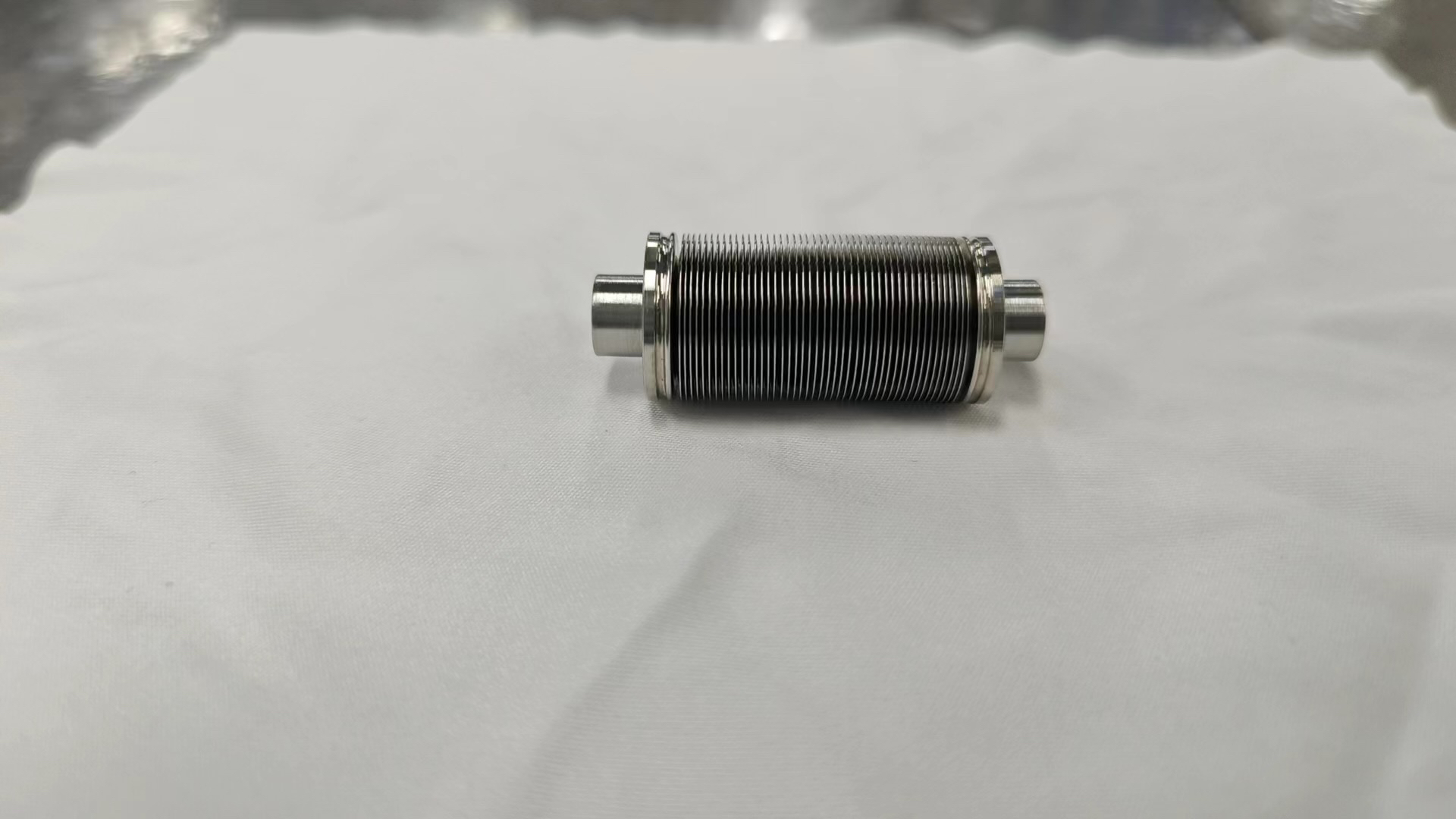
Substrate holders rotate — single rotation for simple coating, planetary systems for uniformity on complex parts. The rotary feedthrough that drives them is almost always bellows-sealed: an edge welded bellows provides the rotating seal without elastomers, which would outgas, generate particles, and fail under continuous cycling. This is the same reason bellows seals dominate vacuum valve stems, as covered in our bellows valve comparison.
Linear motion: shutters, masks and shields
Targets must be conditioned (pre-sputtered behind a shutter) before deposition begins; masks define coated areas; shields protect chamber walls. These mechanisms translate into bellows-sealed linear feedthroughs and pneumatic actuators, cycled thousands of times per week in production tools. Cycle life and particle-free operation are the specification drivers.
Gate and slit valves
Cluster tools move substrates between load lock, transfer and process chambers through slit and gate valves that isolate each vacuum domain. The bellows sealing these valves is a consumable that defines maintenance intervals — a market we examined in slit valve hardware.
Target change and positioning
Sputtering targets erode and are replaced constantly in production. Tilting cathode assemblies and target transport mechanisms rely on flexible vacuum connections — bellows that accommodate alignment motion while staying leak-tight, designed with the stroke and spring-rate discipline in our bellows design guide.
Pumping lines and vibration isolation
Turbo and cryo pumps connect through lines that must not transmit vibration to the substrate stage; bellows sections provide that isolation, and pump isolation valves protect the tool during venting and standby.
Why Bellows Seals Beat Elastomers in Coating Tools
- Particle generation — elastomer seals shed particles and trap debris; a metal bellows seal is clean, which matters when a single particle becomes a film defect.
- Outgassing — metal seals contribute negligible hydrocarbons to the residual gas; O-rings are a chronic water and hydrocarbon source in coating chambers.
- Lifetime — a properly specified welded bellows outlasts elastomeric seals by an order of magnitude in cycling service, cutting maintenance events that vent the chamber.
- Temperature and process compatibility — substrate heating and plasma exposure degrade polymers; metals do not care.
Where the Market Is Going
The 5–6% equipment growth rate understates the component opportunity. Tool fleets are aging into replacement cycles; new display and solar capacity in Asia adds deposition lines; and each retrofit or rebuild consumes a fresh set of bellows, seals and feedthroughs — the long-tail demand pattern we described for the broader vacuum equipment market. For tool builders and rebuilders, sourcing components with documented leak rates and cycle life is what turns uptime into a competitive advantage.
The Alpha Technology Angle
Alpha Technology manufactures custom edge welded bellows, vacuum feedthroughs and sealed assemblies for coating equipment — rotary and linear motion seals, valve bellows, and pump-line isolations, helium-leak-tested and serialized. Deposition tool builders and rebuild shops can contact our engineering team with drawings or sample parts for quotation.
FAQ
Why do sputtering systems need vacuum?
Sputtered films are contaminated by residual water, oxygen and hydrocarbons. The chamber is pumped to about 10-6 mbar before backfilling with pure argon to roughly 10-3 mbar, where the plasma forms and films grow clean.
Why are bellows used in sputtering systems?
Metal bellows seal rotary and linear motion — substrate rotation, shutters, valves, cathode tilt — without elastomers, eliminating particle generation and outgassing while surviving millions of cycles.
How big is the sputtering equipment market?
Mordor Intelligence values sputtering cathodes at $1.36 billion in 2026, growing 5.62% annually to $1.79 billion by 2031; total sputtering equipment is projected to grow from $2.67 billion in 2025 to $4.59 billion by 2034.
What industries use magnetron sputtering?
Semiconductor metallization, optical and anti-reflective coatings, architectural glass, hard and decorative tool coatings, thin-film solar and data-storage media.
Rebuilding or scaling up deposition equipment? Contact Alpha Technology for leak-tested bellows and feedthroughs built for coating tools.