
Yole Group’s 2026 panel-level packaging (PLP) report projects the market to grow more than 40% CAGR through 2031, driven by ultra-high-density fan-out and 2.5D packaging for AI, HPC and chiplet architectures. Panel-level processing — moving from round 300mm wafers to square panels (up to 600×600mm and beyond) — promises dramatic cost-per-area reductions. But it also rewrites the rules for vacuum equipment.
Here’s the engineering reality: a panel is four to nine times the area of a wafer, and every vacuum process that works on wafers must work on panels — with much tighter uniformity, bigger chambers, and larger moving assemblies. For vacuum component suppliers, PLP is both an opportunity and a spec nightmare.
Why PLP Is Vacuum-Intensive
Almost every process step in fan-out panel packaging happens in vacuum or controlled atmosphere:
- RDL (redistribution layer) deposition: PVD sputtering of Cu/Ti seed layers across a 600mm panel — larger targets, larger shutters, longer strokes.
- Dielectric coating: CVD or spin-and-cure approaches need controlled environments; plasma-enhanced steps run at low pressure.
- Plating and etching: wet processes are atmospheric, but the plasma descum and etch steps are vacuum.
- Die placement and bonding: chiplet assembly increasingly uses vacuum-compatible placement to avoid voiding in underfill and bonding interfaces.
What PLP Changes for Bellows and Feedthroughs
1. Bigger strokes, higher precision
Panel handling stages travel longer distances than wafer stages. Edge welded bellows for panel tools need longer stroke capability while keeping spring rates low enough not to fight the motion system — exactly the envelope-driven design covered in our design guide.
2. Larger chambers, more penetrations
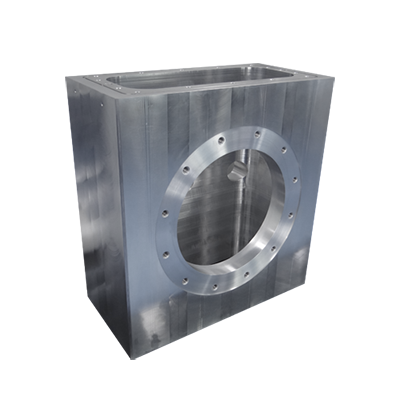
A 600mm panel chamber has more ports for gas, RF, power, sensors and viewports than a wafer chamber. Each penetration is a potential leak path — vacuum feedthroughs with consistent sealing across many units become a logistics and quality exercise as much as an engineering one.
3. Thermal management at scale
Heating a panel uniformly is harder than heating a wafer. Bellows that connect heated stages to the chamber wall must tolerate continuous high temperature (200-400 °C) with low heat conduction — thin-wall, low-conductivity designs are preferred.
4. Uniformity-driven leak specs
At panel scale, any parasitic leak degrades process uniformity. Expect acceptance criteria of 1×10⁻⁹ mbar·L/s on every sealed component — the same standard Alpha Technology ships on all welded assemblies.
What PLP Equipment Builders Should Specify
- Bellows with validated cycle life at panel-tool duty cycles (long strokes, continuous operation).
- Feedthroughs rated for high-temperature bakeout with non-magnetic options for some process heads.
- Full documentation: leak test reports, material certs, and assembly cleanliness records.
- A supplier who designs to envelope — because panel tool envelopes are still being standardized.
Alpha Technology for Panel-Level Tools
Alpha Technology designs and builds custom edge welded bellows and vacuum feedthroughs for large-format vacuum equipment, including panel processing prototypes and first-generation tools. Our custom bellows handle long strokes and high temperatures; the material guide helps you pick the right alloy for continuous 400 °C service.
FAQ
What is panel-level packaging?
Manufacturing fan-out and 2.5D/3D packaging on square glass or metal panels instead of round wafers, reducing cost per area by processing multiple chips at once.
Why is vacuum important in PLP?
Deposition, plasma etching, dielectric curing and void-free bonding all require controlled low-pressure environments; panel-scale uniformity demands excellent chamber integrity.
Are wafer-fab vacuum components reusable in PLP tools?
Sometimes, but panels need longer strokes, bigger chambers and higher thermal duty — components are often custom-designed for the panel format.
Does Alpha Technology make components for prototype tools?
Yes — we work with equipment developers from the prototype stage, providing custom bellows and feedthroughs as their envelope evolves.
Designing a panel-level vacuum tool? Contact Alpha Technology — send your envelope and duty cycle and get a custom component design.