
In March 2025, ULVAC announced it was developing a next-generation dilution refrigerator specifically for quantum computers — a machine that cools superconducting qubits to temperatures below 10 millikelvin. The announcement is part of a wider trend: as quantum processors grow from hundreds to thousands of qubits, the cryogenic vacuum infrastructure that surrounds them has become one of the industry’s hardest engineering problems.
Here is the part that rarely makes the headlines: a dilution refrigerator is a vacuum system wrapped around a cryostat. The qubit chip sits in a hermetically sealed, high-vacuum (often UHV) enclosure at millikelvin temperatures, and every control line, every microwave signal, every measurement wire enters that cold vacuum through a feedthrough. If the vacuum degrades, the qubits lose coherence. If a feedthrough leaks, the entire refrigerator must be warmed up — days of lost lab time per incident.
Why Quantum Chips Need Vacuum (and Cold)
Superconducting qubits are macroscopic circuits whose quantum states are fragile. They operate at millikelvin temperatures to suppress thermal noise, inside a vacuum to:
- Eliminate gas collisions and adsorption that disturb the chip surface and its Josephson junctions;
- Prevent water and hydrocarbon condensation on the chip and its wiring;
- Provide thermal isolation between the ~4 K stage and the 10 mK mixing chamber.
The Vacuum Hardware That Makes Quantum Possible
1. Feedthroughs for the “quantum wiring”
A thousand-qubit machine needs thousands of coaxial and DC lines entering the cold zone. Multi-pin and RF vacuum feedthroughs must combine electrical performance (low insertion loss at microwave frequencies) with leak integrity at cryogenic temperature. Thermal contraction across a 300 K to 4 K gradient is brutal on seals — this is where metal-sealed, bellows-compensated designs win.
2. Bellows for thermal and mechanical isolation
Dilution refrigerators contain moving and flexing elements — vibration isolators, pulse-tube cold-head interfaces, and connections between stages that shrink by millimeters as they cool. Edge welded bellows absorb that differential contraction and mechanical vibration while maintaining the vacuum boundary.
3. UHV chambers around the chip
Many quantum teams mount the processor in a removable UHV chamber or sample holder — leak-tight, bakeable, and ventable for chip replacement. The same welded bellows technology used in semiconductor load locks appears here, scaled to a research budget.
Engineering Considerations for Quantum Vacuum Components
- Materials: non-magnetic is non-negotiable — magnetic impurities shift qubit frequencies. SS316L and titanium are standard; AM350 is used where higher strength is needed.
- Low outgassing: the cold surfaces act as cryopumps, so anything warm that outgasses contaminates the chip. Vacuum-fired, cleanroom-handled components only.
- Bakeout tolerance: components must survive 100-200 °C bakeouts to reach the base pressure required.
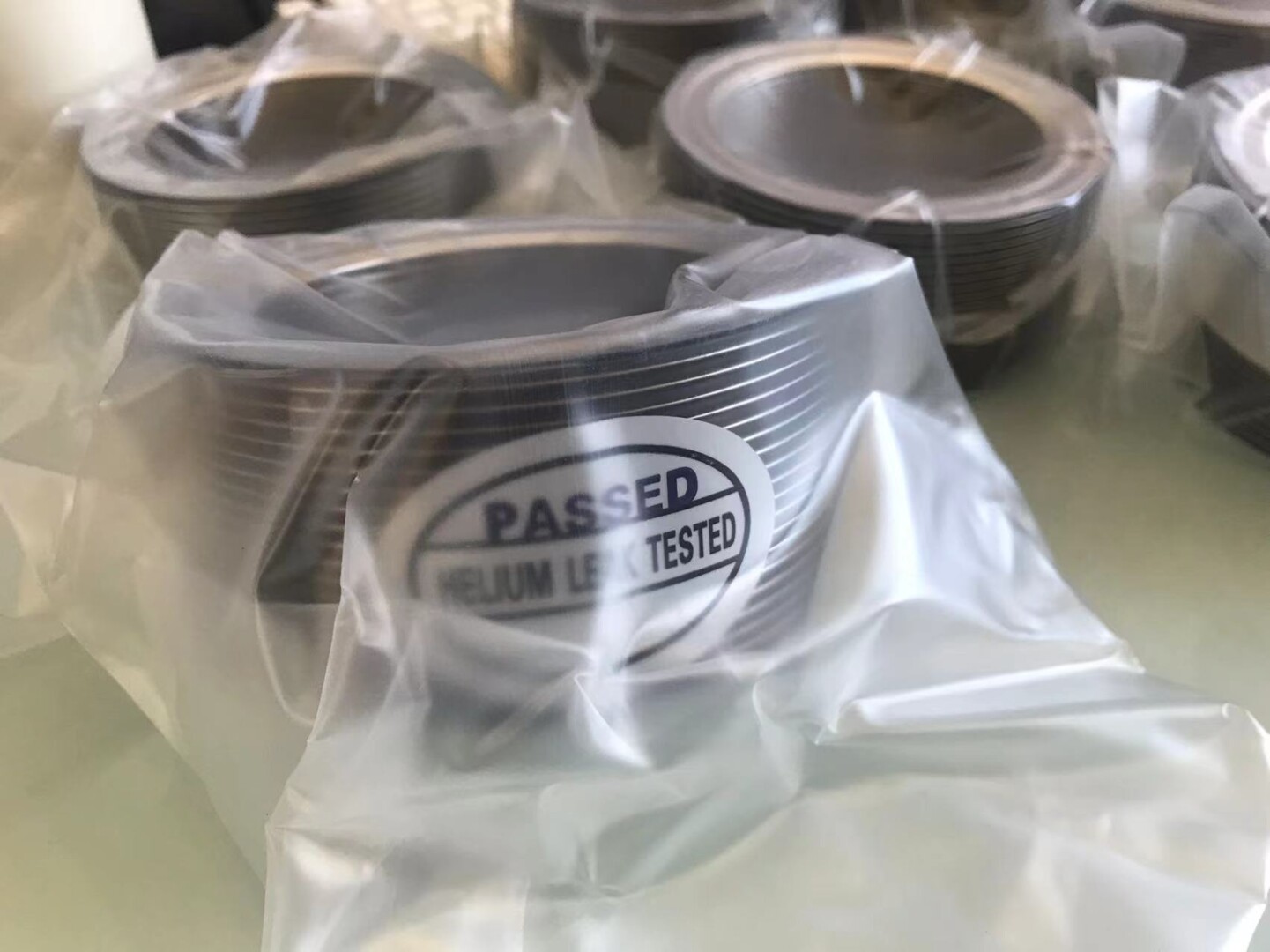
- Leak integrity: the cost of a leak is measured in days of refrigerator downtime — helium leak testing to 1×10⁻⁹ mbar·L/s on every part is the baseline.
Alpha Technology’s Quantum-Ready Components
Alpha Technology supplies vacuum feedthroughs, edge welded bellows and custom UHV assemblies for quantum computing research — non-magnetic materials, UHV cleaning, helium leak testing and full material traceability as standard. For guidance on material selection in cryogenic service, our material guide compares 316L, AM350 and Inconel under thermal cycling; the design guide covers the envelope and fatigue math.
FAQ
What temperature do dilution refrigerators reach?
Commercial systems reach ~10 mK at the mixing chamber stage, with the qubit chip typically mounted at that coldest plate.
Why can’t you just put the qubit in a normal vacuum chamber?
You need both vacuum and millikelvin temperature. The vacuum prevents contamination and provides thermal isolation; the dilution refrigerator provides the cold. Both are required simultaneously.
Are standard vacuum components usable in quantum systems?
Often not — non-magnetic materials, low outgassing, bakeout tolerance and cryogenic leak integrity are stricter than general-purpose industrial components.
Does Alpha Technology make non-magnetic feedthroughs?
Yes — our feedthroughs and bellows can be built entirely from non-magnetic 316L/titanium/copper systems for quantum and cryogenic service.
Building or upgrading a quantum vacuum system? Contact Alpha Technology with your feedthrough count, signal types and temperature stages — we’ll help you specify the right hardware.