
In May 2026, NASA confirmed that its Liquid Oxygen Flight Demonstration (LOXSAT) had entered final pre-launch testing, and reported plans for a satellite that will test technologies for storing and transferring super-chilled cryogenic fuels in orbit. The goal is ambitious: build orbital “gas stations” that let spacecraft refuel in space, enabling longer lunar missions and eventually Mars transit. Blue Origin, meanwhile, is testing cryogenic fuel transfer in a vacuum environment at NASA’s Marshall Space Flight Center.
Behind these headlines sits a class of engineering that most people never see: cryogenic vacuum hardware. Liquid oxygen boils at 90 K, liquid hydrogen at 20 K. Storing and moving them in space requires vacuum-jacketed lines, bellows that flex at cryogenic temperatures, and feedthroughs that carry sensors and heaters across the vacuum boundary — components that must survive launch vibration, thermal cycling, and decades without maintenance.
Why Vacuum Is the Insulator of Choice in Space
In orbit there is no atmosphere to convect heat, but radiative and conductive paths still boil off propellant. The most effective insulation is a vacuum jacket: the fuel line is surrounded by an evacuated annulus, so conduction is nearly eliminated. Every joint in that jacket needs a seal or a bellows — and every penetration (sensor wire, heater, fill/drain port) needs a cryogenic feedthrough.
The Cryogenic Vacuum Components Doing the Work
1. Bellows for thermal contraction and flexure
From launch to orbit, hardware experiences temperature swings of hundreds of kelvin. Aluminum and stainless lines shrink by millimeters; bellows absorb that contraction and the flexure of moving joints. Edge welded bellows are used in cryogenic couplings, expansion joints, and valve stems because they seal absolutely while flexing.
2. Feedthroughs that survive 20 K
Cryogenic instrumentation — temperature sensors, liquid-level probes, heater power — crosses the vacuum jacket through feedthroughs. At 20 K, elastomer seals become glass-hard and leak; metal-sealed or welded designs are required. Thermal contraction across the seal interface must be managed by design, not hope.
3. Helium leak testing as a launch requirement
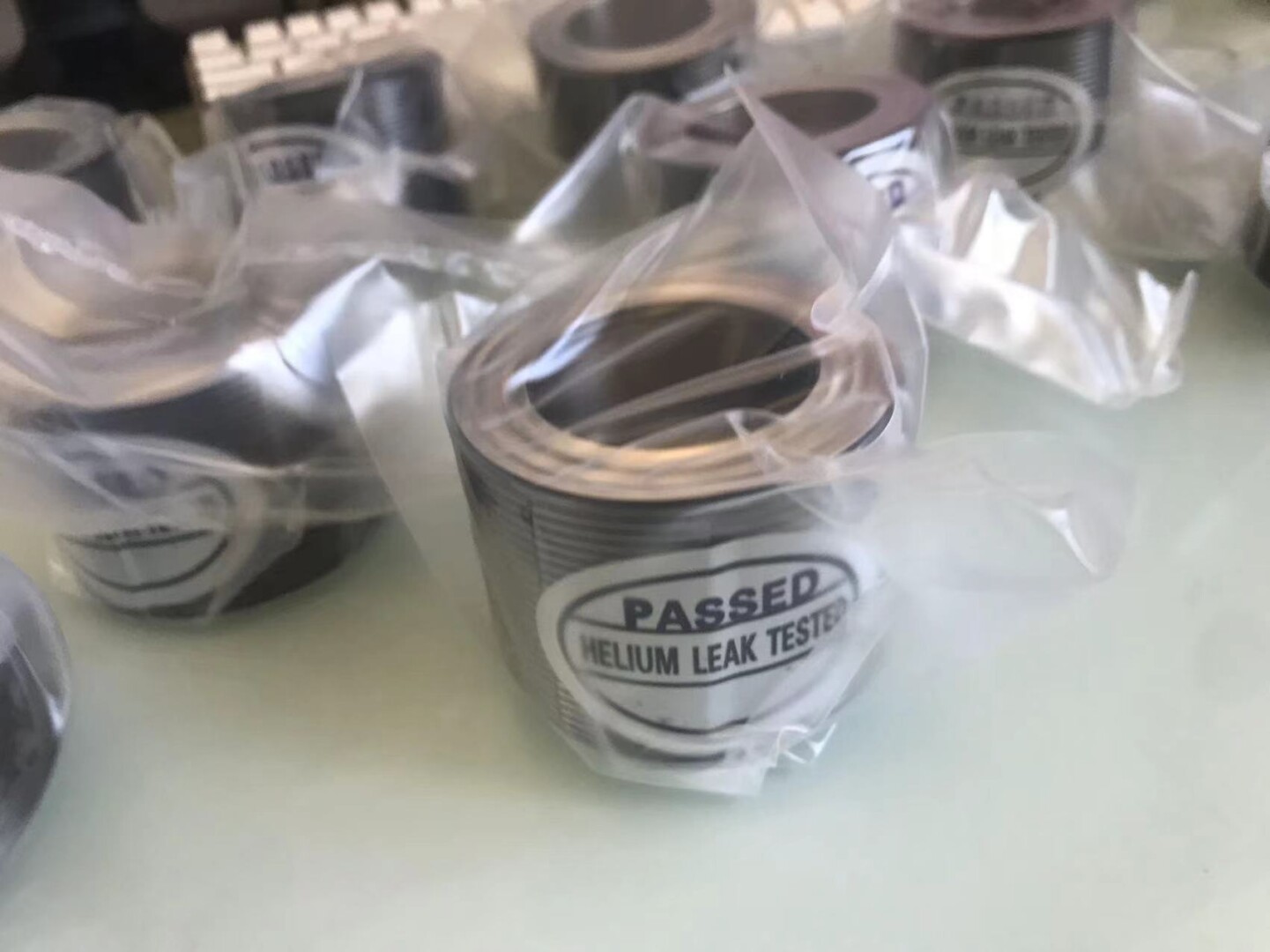
Every cryogenic component is helium leak tested before acceptance — the cost of a space failure is measured in hundreds of millions of dollars. Leak rates of 1×10⁻⁹ mbar·L/s and below are standard acceptance criteria.
Designing for Cryogenic Duty Cycles
- Material selection matters twice: at cryogenic temperature, some stainless steels become brittle. 316L and Inconel retain ductility; the material guide explains the trade-offs.
- Fatigue life under thermal cycling: a bellows in a cryogenic joint cycles thermally far more often than mechanically — convolution geometry should be optimized for that.
- Cleanliness: hydrocarbons freeze out at 20 K and block orifices; components must be delivered ultrasonically cleaned and sealed.
- Documentation: space programs demand full material traceability and test records — Alpha Technology provides both.
Alpha Technology for Cryogenic and Space Programs
Alpha Technology manufactures edge welded bellows, vacuum feedthroughs and custom assemblies for cryogenic research, space hardware and vacuum systems — built from 316L, Inconel and titanium, helium leak tested, and delivered with complete documentation. If you are qualifying components for cryogenic service, the design guide covers the envelope, stroke and cycle-life calculations you’ll need.
FAQ
Why do cryogenic fuel systems need vacuum insulation in space?
In a vacuum environment you cannot use convection or air-gap insulation effectively; an evacuated jacket around the line is the most effective way to block conductive heat into the propellant.
What is LOXSAT?
NASA’s Liquid Oxygen Flight Demonstration — a small satellite that will demonstrate storage and transfer of liquid oxygen in orbit, a key step toward orbital refueling depots.
Why can’t elastomer seals be used at 20 K?
Elastomers lose elasticity and can crack at cryogenic temperatures, and their outgassing contaminates optics and sensors. Metal-sealed or welded designs are required.
Can bellows survive repeated cryogenic thermal cycling?
Yes, when designed for it — proper material (316L/Inconel), appropriate convolution geometry and validated fatigue life. That is exactly the engineering Alpha Technology provides.
Qualifying cryogenic vacuum components for your program? Contact Alpha Technology with your temperature range, pressure and test requirements.