
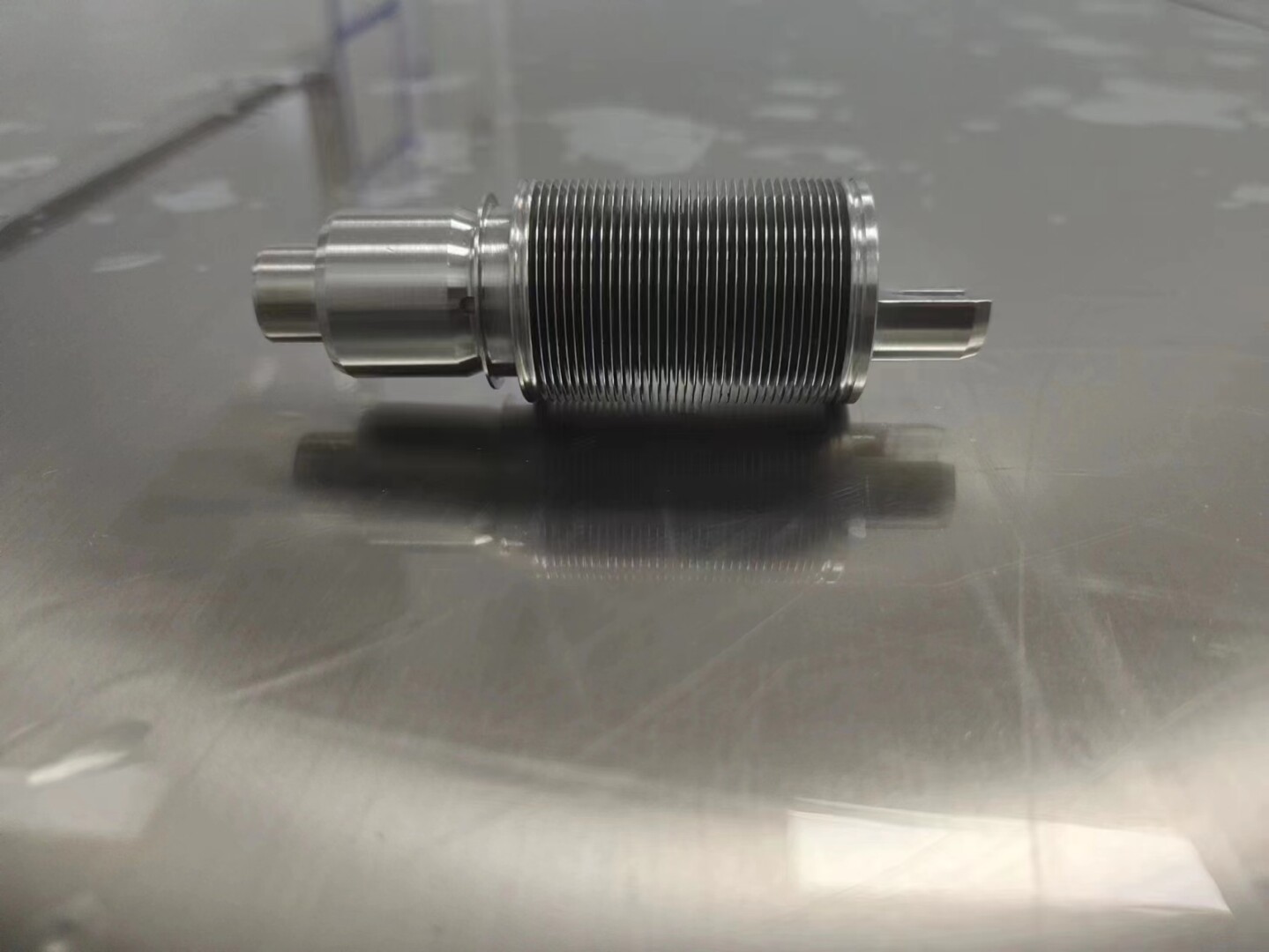
On August 2, 2026, Bloomberg Television featured a next-generation surgical robot built to transform the operating room — the latest sign of a market that analysts cannot stop revising upward. MarketsandMarkets projects global surgical robots from $13.69 billion in 2025 to $27.14 billion by 2030 at 14.7% CAGR, and Precedence Research reported on July 13, 2026 that the U.S. surgical robotics market alone would grow from $4.46 billion in 2025 to $18.75 billion by 2035. Behind the growth is a mechanical reality: a surgical robot is a precision motion machine whose instruments must actuate inside a living patient — and a surprising amount of that motion is carried by edge welded bellows.
Most engineers meet bellows in vacuum systems. Medical device designers meet them somewhere far more demanding: at the end of an instrument, flexing millions of times, sterilized hundreds of times, in a form factor measured in millimeters.
Where Bellows Appear in Surgical Systems
1. Instrument wrists and actuation
Da Vinci-class systems and their challengers route four to seven degrees of freedom through an instrument shaft only 5–8 mm in diameter. Wrist motion is driven by cables and pushrods, but the instrument’s internal pressure balancing, sealing and flexible joints increasingly use micro edge welded bellows — hermetic, backlash-free, and capable of millions of flex cycles at diameters under 3 mm. The envelope advantage is decisive: edge welded bellows deliver stroke in a fraction of the length formed bellows need, exactly the design constraint documented in our custom bellows specification guide.
2. Fluidics: irrigation, suction and insufflation
Robotic surgery depends on precise fluid control — saline irrigation, suction, and CO2 insufflation to open the surgical cavity. The pumps and valves in those fluidics lines use bellows as both sealing elements and sensing diaphragms, isolating the drive mechanism from the sterile fluid path. A bellows-based pump has no sliding seal to wear, no particulate to shed, and no lubricant to contaminate the fluid — the same logic that drives bellows pumps in lab automation and semiconductor chemistry handling.
3. Sterilization-tolerant actuators
Every reusable surgical instrument is sterilized — typically 100–500 autoclave cycles at 121–134°C steam, plus chemical and radiation methods. Elastomer seals degrade across those cycles; welded metal bellows do not. Instrument OEMs are replacing elastomer-covered actuator shafts with edge welded bellows seals precisely to extend instrument life and eliminate the failure mode where worn seals shed debris into the sterile field.
Materials and Cleanliness for Medical Service
Medical bellows are overwhelmingly 316L stainless: it is biocompatible, corrosion-resistant, and autoclave-tolerant. Wall thicknesses run 0.03–0.10 mm in the smallest sizes, and every weld is validated for pinhole integrity. Surface finish, cleanliness and passivation follow medical device standards, and lot traceability is non-negotiable — the same serialized-documentation discipline our helium leak testing guide describes for vacuum components, applied to a different acceptance standard: biocompatibility and sterility.
Beyond Surgery: Bellows Across the Medical Portfolio
The same precision-bellows physics shows up throughout medical technology: implantable drug pumps use bellows as the flexible reservoir that delivers medication at constant pressure; insulin pumps meter microliter volumes through bellows-based mechanisms; pressure sensors and catheters use bellows as pressure-sensing elements; and dental and orthopedic handpieces run bellows-sealed air motors. As the surgical robotics market compounds toward $27 billion by 2030, the component pool feeding it — micro bellows, miniature feedthroughs and bellows pumps — grows on the same curve.
The Miniature Envelope Problem
The hardest part of medical bellows is not the metallurgy; it is the geometry. A wrist joint bellows may need 5 mm of stroke inside a 4 mm bore, with a fatigue life of 10 million cycles and zero hysteresis. That combination — high stroke ratio, tiny envelope, extreme cycle life — is precisely where edge welded bellows outperform every alternative, which is why the technology migrated from vacuum engineering into the operating room in the first place. The design guide walks through the cycle-life and spring-rate math that medical OEMs now apply to instrument development.
Alpha Technology for Medical Device OEMs
Alpha Technology manufactures custom micro edge welded bellows from 3 mm bore upward for surgical instruments, fluidics and sterilizable actuators — 316L with documented surface finish, cleanroom assembly and 100% leak testing per lot. Contact our engineering team with your bore, stroke, cycle and sterilization requirements.
FAQ
Why are bellows used in surgical robots?
Instrument wrists, fluidics valves and sterilizable actuators need hermetic, backlash-free, particle-free motion; welded metal bellows deliver stroke in tight envelopes without sliding seals.
What is the surgical robotics market size?
MarketsandMarkets projects global surgical robots from $13.69 billion in 2025 to $27.14 billion by 2030 at 14.7% CAGR; the U.S. market is forecast to reach $18.75 billion by 2035.
Can bellows survive autoclave sterilization?
Yes — welded 316L bellows tolerate hundreds of autoclave cycles at 121–134°C where elastomer seals age, crack and shed debris.
What materials are used for medical bellows?
Biocompatible 316L stainless is standard, with wall thicknesses of 0.03–0.10 mm in miniature sizes and validated weld integrity.
Developing an instrument or fluidics system that needs micro bellows? Contact Alpha Technology with your envelope and cycle-life targets.