
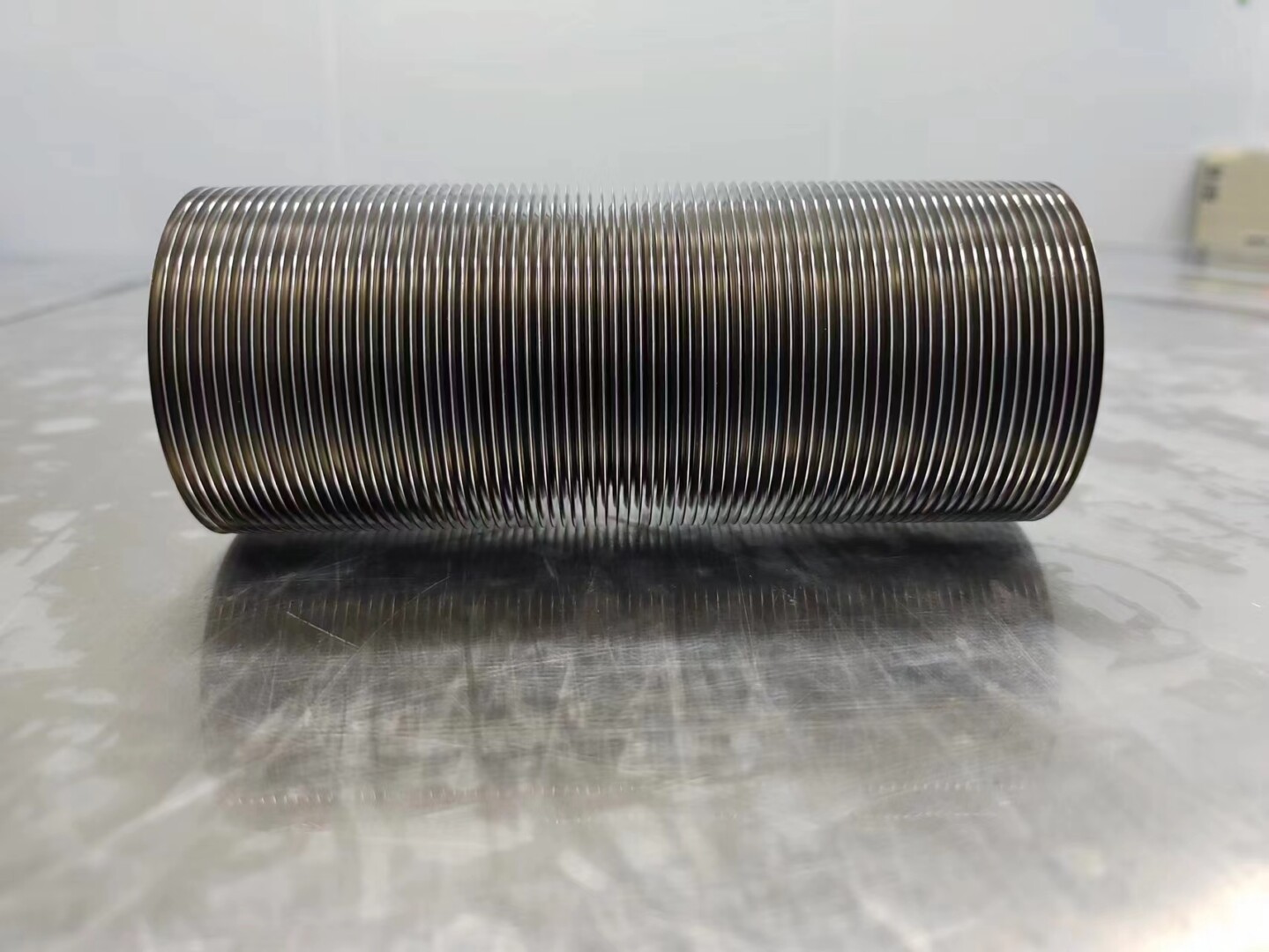
At K-Display 2026, Omdia analysts projected that AMOLED will account for 44% of total flat-panel display revenue by 2033, powered by OLED notebooks, automotive displays and foldable smartphones. The equipment side of the story is equally strong: WiseGuy Reports sized the OLED deposition equipment market at $2.69 billion in 2025, growing to $5.2 billion by 2035 at 6.9% CAGR. What those forecasts rarely mention is that an OLED fab is, physically, one of the largest vacuum manufacturing systems on Earth — and every one of its deposition tools is sealed and moved by edge welded bellows.
An OLED panel is a stack of organic films, each just tens of nanometers thick, evaporated onto glass inside vacuum. If the process atmosphere, the glass handling or the shutter mechanisms shed a single particle or admit a trace of moisture, the pixel fails — and the panel is scrap.
The Vacuum Architecture of an OLED Deposition Tool
A state-of-the-art OLED evaporation system runs a continuous vacuum path from glass entry to sealed panel: substrates enter through load locks, move robot-to-robot through transfer chambers, and pass over linear evaporation sources in a process chamber held below 10-6 mbar. Organic materials are moisture- and oxygen-intolerant, so the entire path is a dry vacuum envelope. The architecture is the semiconductor cluster tool’s cousin — which is why the vacuum engineering logic from our UHV and semiconductor bellows guide applies directly, scaled up to Gen 8.6 glass substrates.
Where Bellows Do the Work in a Display Fab
1. Glass-handling robots and transfer
Glass substrates move through the tool on vacuum robots with bellows-sealed arms — the same motion-seal engineering as wafer robots, analyzed in our wafer handling robot guide, but handling panels that are meters across. Each robot joint, lift and rotation crosses the vacuum boundary through edge welded bellows rated for millions of cycles.
2. Evaporation sources and shutter mechanisms
Linear evaporation sources deposit organic layers through precision masks. Between depositions, shutters physically block the source to control film thickness to the nanometer — and every shutter is driven by a bellows-sealed actuator inside the hot vacuum chamber. The same applies to mask-handling mechanisms and source refill ports: all motion across the source chamber wall is bellows-sealed, because even the smallest elastomer seal would outgas and poison the organic films.
3. Load locks and alignment stages
Glass enters and exits through load locks whose doors and lift pins are bellows-sealed. Alignment stages that register masks to panels move on bellows-sealed drives with sub-micron repeatability. In a Gen 8.6 line running tens of thousands of panels per month, those bellows cycle millions of times per year — the fatigue and spring-rate engineering covered in our bellows design guide.
Why Bellows Matter for OLED Yield
OLED yield is decided by defects per million — particles, moisture and film-thickness variation. Edge welded bellows contribute on all three fronts: no sliding contact means no wear particles, all-metal construction means zero outgassing in the process chamber, and stable spring rate means repeatable shutter and stage motion for uniform films. Materials are typically 316L and AM350, chosen per the logic of our bellows material guide; components are helium leak tested to below 1×10⁻⁹ mbar·L/s using the methods in our leak testing guide. When a display maker quotes yield in the high nineties, the bellows inside the tool are quietly part of that number.
From Smartphones to Gen 8.6: The Market Push
As AMOLED climbs toward 44% of display revenue, fabs are moving to larger glass — Gen 8.6 (2,290 × 2,620 mm) and beyond — which makes every bellows bigger, every stroke longer, and every transfer robot more heavily loaded. The equipment forecast of $5.2 billion by 2035 translates into hundreds of new deposition chambers, each consuming edge welded bellows, vacuum feedthroughs and bellows-sealed valves by the dozen. Display manufacturing is now one of the largest consumers of vacuum hardware outside semiconductor — and one of the most demanding for cleanliness.
Alpha Technology for Display Equipment
Alpha Technology supplies custom edge welded bellows, vacuum feedthroughs and short-stroke precision bellows for OLED evaporation tools — source shutters, glass robots, load locks and alignment stages — with semiconductor-grade cleanliness and 100% helium leak testing. Contact our engineering team with your chamber, stroke and cleanliness requirements.
FAQ
Why is OLED manufacturing a vacuum process?
OLED films are evaporated nanometer-thin layers of organic material that degrade in moisture and oxygen; deposition therefore runs inside dry vacuum chambers at 10-6 mbar or better.
Where are bellows used in OLED fabs?
In glass-handling robot arms, evaporation-source shutters, mask handling, load-lock doors, lift pins and alignment stages.
How big is the OLED deposition equipment market?
WiseGuy Reports sizes it at $2.69 billion in 2025, growing to $5.2 billion by 2035 at 6.9% CAGR.
Why do OLED tools use welded metal bellows?
They generate no wear particles, outgas nothing, and deliver stable, repeatable motion — three requirements that decide OLED yield.
Building deposition or glass-handling equipment? Contact Alpha Technology with your motion and cleanliness specifications.