
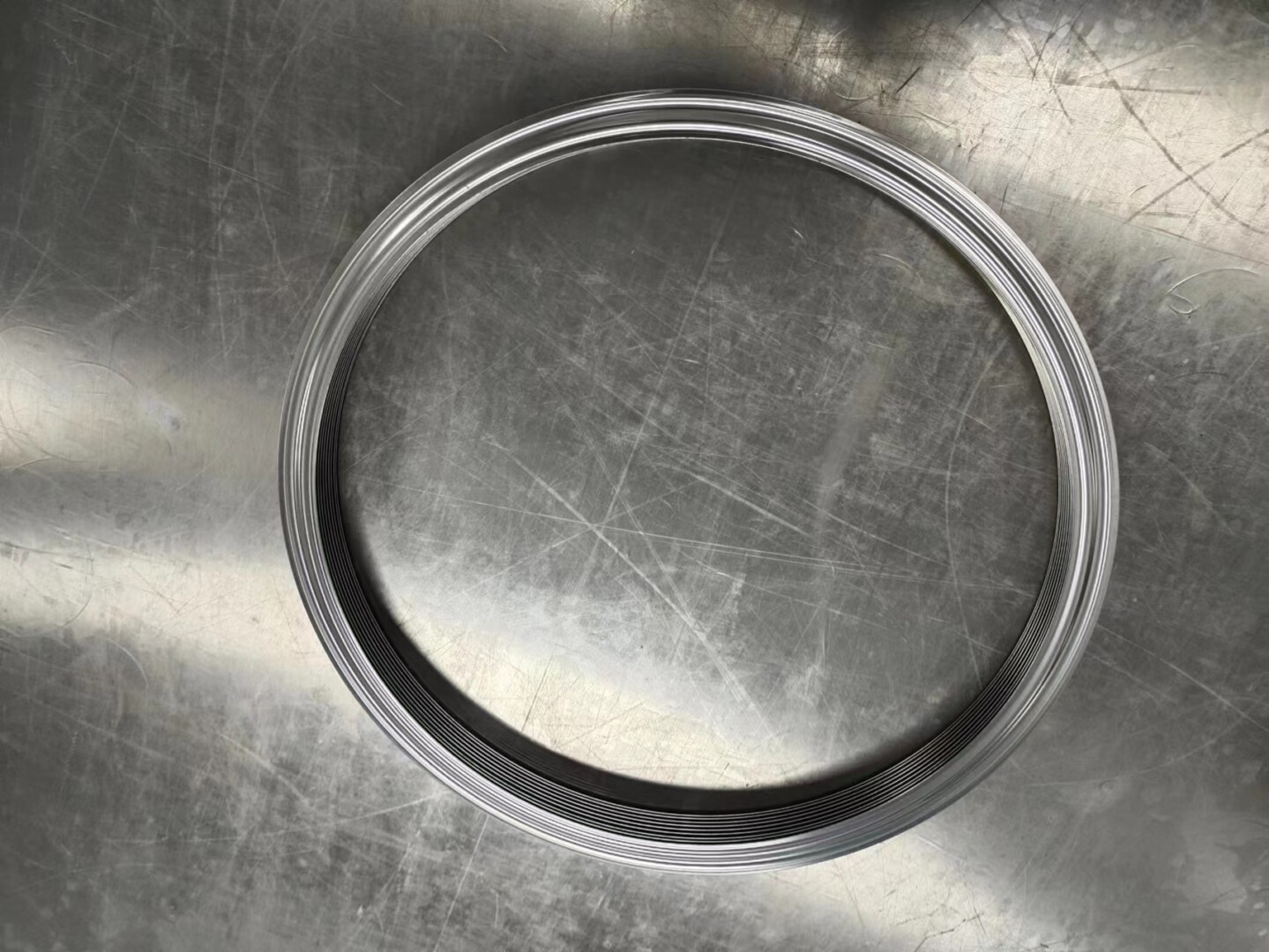
On June 29, 2026, CERN switched off the Large Hadron Collider for the final time before its biggest upgrade, entering Long Shutdown 3 (LS3) — a multi-year programme to install the High-Luminosity LHC (HL-LHC), with stronger superconducting magnets and beams bright enough to multiply collision rates tenfold. The same week, vacuum valve maker VAT published its long-running project story on the LHC, describing how vacuum valves maintain 10-11 mbar beam-pipe pressure and reliably seal off accelerator sectors. Between the shutdown headlines and the component-level reality sits an engineering constant that never appears in the press release: the accelerator vacuum system is held together by edge welded bellows.
A particle accelerator is the largest vacuum system ever built. Its beam pipes, magnets, cryostats and detectors form tens of kilometers of vacuum envelope that must flex, expand and isolate on demand — and every flexible connection in that envelope is a welded metal bellows.
Vacuum at 10⁻¹¹ mbar: What the LHC Actually Requires
The LHC’s beam pipes operate at 10-10 to 10-11 mbar, several orders of magnitude deeper than semiconductor process vacuum. At that pressure, the residual gas density is so low that beam-gas collisions are negligible — essential when circulating two counter-rotating beams of protons at 6.8 TeV per beam. Achieving and holding UHV means every component is baked at 200–300°C, every joint is metal-sealed or welded, and every moving or flexing element is a metal bellows. This is the extreme end of the component discipline described in our UHV bellows guide — bakeable, all-metal, and leak-tight to 1×10-11 mbar·L/s or better.
Where Bellows Matter in an Accelerator
1. Beam-pipe expansion joints
Beam pipes heat and cool through bake-out and operation, and the machine’s 27 km of magnets expand and contract with temperature. Edge welded bellows expansion joints absorb that differential motion while maintaining the beam aperture — a non-negotiable job with zero margin for leaks.
2. Vacuum isolation and sector valves
The accelerator is divided into sectors so that one section can be vented for maintenance while the rest stays under vacuum. All-metal gate valves, bellows-sealed like the semiconductor valves analyzed in our slit valve and gate valve guide, close in milliseconds to protect the beam line — VAT’s own LHC story centers on exactly these valves.
3. Cryogenic and magnet systems
LHC magnets run at 1.9 K in superfluid helium, and the cryostats connect to warm vacuum regions through bellows that handle extreme thermal gradients. When a magnet quenches, components can move millimeters in seconds — bellows absorb that motion. The thermal-cycling discipline for such service is documented in our cryogenic bellows guide.
4. Detector and experimental-area interfaces
Around the four collision points, ATLAS, CMS, ALICE and LHCb connect their detectors to the beam pipe through bellows-integrated transitions, feedthroughs and service ports. Detector upgrades during LS3 — including new inner trackers — mean thousands of new vacuum feedthroughs and bellows assemblies going into the caverns.
The HL-LHC Challenge: More Luminosity, Same Vacuum Budget
HL-LHC will deliver ten times the integrated luminosity of the original machine, with crab cavities, new superconducting magnets and brighter beams. More luminosity means more beam-induced heating of the beam pipe, more stringent alignment, and more demanding vacuum performance in the interaction regions. For vacuum component suppliers, the LS3 programme is a multi-year, high-tolerance order book: new bellows expansion joints, sector valves, and cryogenic transitions, all documented to accelerator quality. The same pattern — big science driving precision vacuum hardware — plays out across the fourth-generation synchrotrons we covered earlier, and across fusion machines like SPARC: when scientists build machines at the limit of vacuum, bellows are the flexible interface that makes them serviceable.
Testing Accelerator-Grade Bellows
Accelerator bellows are accepted with helium leak rates below 1×10⁻¹⁰ mbar·L/s, validated after bake-out and after thousands of flex cycles, with full material and weld traceability. The test methods — helium mass spectrometry, pressure-hold and cycling — are the ones detailed in our helium leak testing guide, applied at the extreme end of the scale. Every bellows that enters an accelerator tunnel carries its own serialized test record, because the tunnel is only as reliable as its weakest weld.
Alpha Technology for Accelerator Programs
Alpha Technology supplies custom edge welded bellows, vacuum feedthroughs and bellows-sealed valves for beam lines, cryostats, detectors and test facilities — bakeable alloys, UHV-quality welds, and 100% helium leak testing with serialized documentation. Contact our engineering team with your aperture, bake-out and cycle requirements.
FAQ
Why did CERN shut down the LHC in 2026?
The LHC entered Long Shutdown 3 on 29 June 2026 to install the High-Luminosity LHC upgrade — stronger superconducting magnets, crab cavities and brighter beams for tenfold integrated luminosity.
Where are bellows used in particle accelerators?
In beam-pipe expansion joints, sector isolation valves, cryogenic transitions, detector interfaces and service feedthroughs along the vacuum envelope.
What vacuum level do accelerators run at?
The LHC beam pipes operate at 10-10 to 10-11 mbar, with bellows accepted at helium leak rates below 1×10⁻¹⁰ mbar·L/s.
Why metal bellows in accelerators?
Only welded metal bellows can absorb thermal expansion, quench motion and alignment shifts while holding UHV, surviving bake-out, and producing no particles in the beam line.
Specifying bellows for an accelerator, beam line or cryostat? Contact Alpha Technology with your vacuum and cycle specifications.