
On July 20, 2026, Fortune Business Insights sized the global wafer handling robots market at $1.71 billion for 2026, projecting it to reach $3.2 billion by 2034 — roughly an 8% compound annual growth rate driven by leading-edge fab builds in Arizona, Dresden, Kumamoto and beyond. A second report, published the same month, valued the narrower vacuum wafer transfer robot segment at $460 million in 2026, doubling to $850 million by 2035. Behind those numbers is an unglamorous but critical component family: the edge welded bellows that seal the rotary and linear motions of every robot arm, transfer stage and load-lock door inside a vacuum cluster tool.
Fabs do not buy bellows; they buy uptime. And in semiconductor automation, uptime is decided by components that move millions of cycles inside vacuum without leaking.
Why a Wafer Robot Is a Moving Vacuum System
A modern cluster tool moves a 300 mm wafer from FOUP to load lock to process chamber without ever exposing it to atmosphere. Each transfer arm must rotate, extend, and pitch under vacuum while maintaining cleanliness that would embarrass a hospital operating room. Every one of those motions crosses the vacuum boundary, and every crossing needs a flexible, hermetic seal: an edge welded metal bellows.
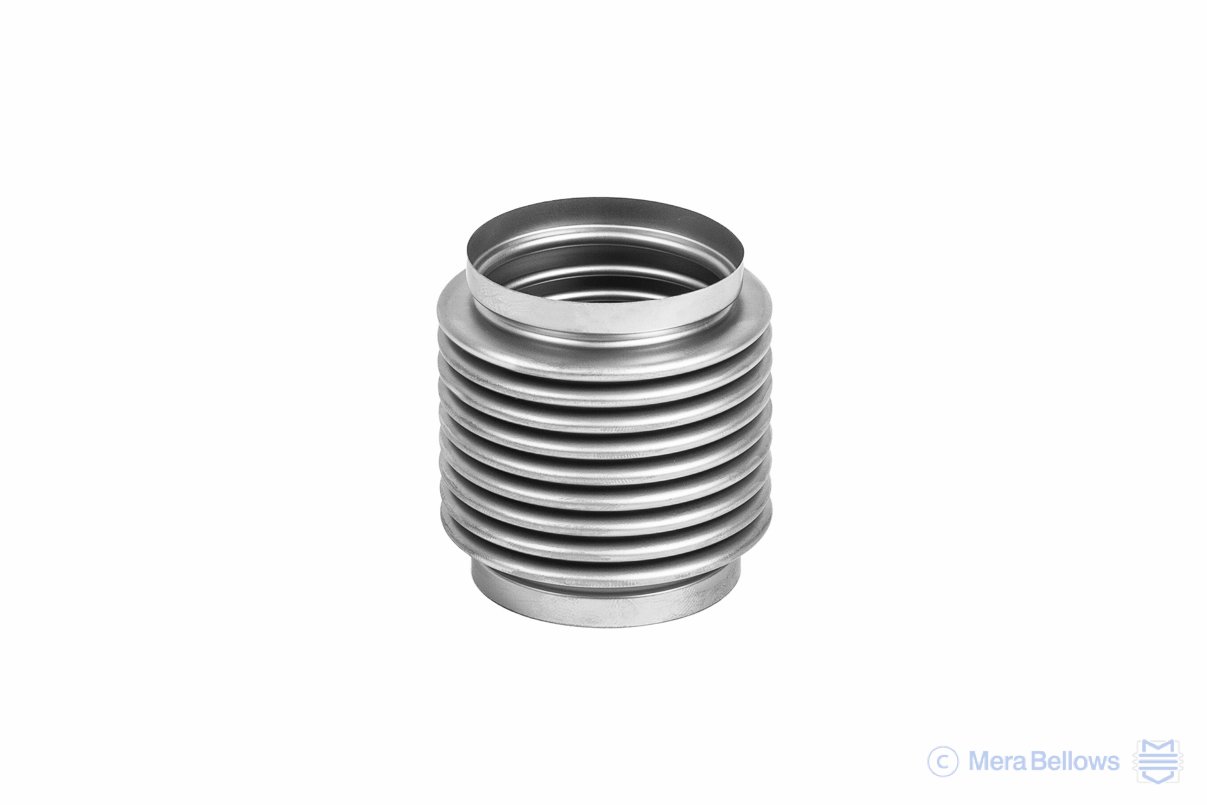
The core physics is well established — edge welded bellows convert motion into metal wall displacement, with no sliding contact, no particles, and no elastomer to outgas. That is why the industry standard for edge welded bellows in vacuum automation is built around thin (0.05–0.15 mm) diaphragm walls welded edge-to-edge, giving stroke-to-length ratios of up to 90% that formed bellows cannot approach.
Where Bellows Appear in Fab Automation
1. Robot arm rotary and linear stages
SCARA-type vacuum robots route rotary and vertical motion through bellows-sealed rotary feedthroughs and telescoping linear bellows. A typical vacuum arm cycles tens of millions of times over its service life; the bellows inside must hold 10-6 mbar with leak rates below 1×10⁻⁹ mbar·L/s. Fatigue design, not material cost, dominates the spec. Our bellows design guide covers the cycle-life and spring-rate calculations engineers apply here.
2. Load-lock doors and lift pins
Every load lock is sealed by a door that cycles per wafer batch. The door actuation and the lift-pin mechanism that raises a wafer off its carrier both pass through the chamber wall via edge welded bellows or bellows-sealed feedthroughs. These are short-stroke, high-cycle components — exactly the duty class covered in our custom bellows specification guide.
3. Slit valve isolation
Between chambers, slit valves isolate process environments. Their gate motion is bellows-sealed too — see our companion analysis of bellows in slit and gate valves for the full component breakdown.
4. Wafer staging and alignment
Alignment stages, centering stations and pre-aligners move wafers in and out of vacuum paths. The same bellows-sealed actuator architecture repeats at smaller scale — a single cluster tool can contain 30 to 60 separate bellows assemblies.
The Cleanliness Factor: Why Metal Beats Everything Else
In a wafer environment, outgassing is measured in parts per billion. Elastomer seals are the first suspect in any contamination event; welded metal bellows are effectively inert. Combined with vacuum feedthroughs that are 100% helium leak tested, a fully metallic motion train gives fab engineers a seal system with no virtual leaks, no particle generation at the sealing line, and no shelf-life issues. That is why OEM toolmakers specify welded bellows for every motion that crosses the vacuum boundary, then validate the whole assembly with the helium leak test methods in our leak testing guide.
Fatigue, Speed and the 8% CAGR Problem
As robot speeds rise to move more wafers per hour, bellows cycle rates climb with them. Faster motion means higher acceleration forces on the bellows wall, higher natural-frequency engineering demands, and tighter fatigue budgets. Vendors who cannot document cycle life, spring rate, and burst pressure for every lot are increasingly excluded from fab supply chains — the same documentation discipline described in our UHV and semiconductor bellows guide.
The market math is straightforward: $3.2 billion of robots by 2034, each carrying dozens of bellows, plus the aftermarket replacement cycle. Wafer handling automation is quietly one of the largest consumption pools for edge welded bellows in the industry.
Alpha Technology for Fab Automation Bellows
Alpha Technology manufactures custom edge welded bellows, short-stroke precision bellows and vacuum feedthroughs for wafer robots, load locks and transfer stages — semiconductor-grade cleanliness, documented fatigue life, and 100% helium leak testing. Contact our engineering team with your stroke, envelope and cycle requirements.
FAQ
Why do wafer handling robots use edge welded bellows?
Because every motion that crosses the vacuum boundary needs a hermetic, particle-free seal; welded metal bellows move without sliding contact and outgas essentially nothing.
How many bellows are in a cluster tool?
A typical vacuum cluster tool contains 30–60 separate bellows assemblies across robot arms, load-lock doors, slit valves and staging stages.
What is the wafer handling robot market size?
Fortune Business Insights valued it at $1.71 billion in 2026, projecting $3.2 billion by 2034 — roughly 8% CAGR.
What leak rate do fab bellows need?
Components are typically accepted at leak rates below 1×10⁻⁹ mbar·L/s, verified by helium mass spectrometry.
Specifying bellows for a wafer robot or load lock? Contact Alpha Technology with your cycle and cleanliness requirements.