
At FCVC 2026 — the International Hydrogen Fuel Cell & Vehicle Congress held in June 2026 — Impact Coatings won the Most Popular Exhibit Award for its PEM water electrolysis coating solutions, displaying vacuum-coated bipolar plates and cell components for green hydrogen production. The award captured a quiet industry shift: the race to scale green hydrogen is increasingly a vacuum coating race.
Green hydrogen — produced by electrolysis powered by renewable electricity — is the industrial world’s answer to decarbonizing steel, chemicals, ammonia and shipping. Scaling it to gigawatt production requires components that survive acidic, high-current electrolysis for tens of thousands of hours, and the enabling technology for those components is PVD coating in vacuum.
Why Electrolyzer Components Need Vacuum Coating
1. Bipolar plates: the cost and corrosion bottleneck
Bipolar plates make up a large share of an electrolyzer stack’s weight and cost. In PEM electrolysis they face high acidity, oxygen-rich anodes and voltages above 2 V — conditions that corrode stainless steel and dissolve unprotected surfaces into the cell. The industry answer is PVD coatings — titanium nitride, niobium, precious-metal or amorphous carbon films deposited in vacuum — that protect plates and, in some designs, let manufacturers substitute cheaper base metals.
2. Cutting precious metal loading
Electrodes traditionally rely on iridium and platinum, whose cost and scarcity cap electrolyzer scale-up. Vacuum deposition puts catalyst material exactly where it is needed — thin, conformal PVD films of iridium or iridium-alloys on porous transport layers — slashing loading per megawatt while maintaining performance. This is the same precision the display and semiconductor industries get from PVD, applied to energy.
3. Porous transport layers and meshes
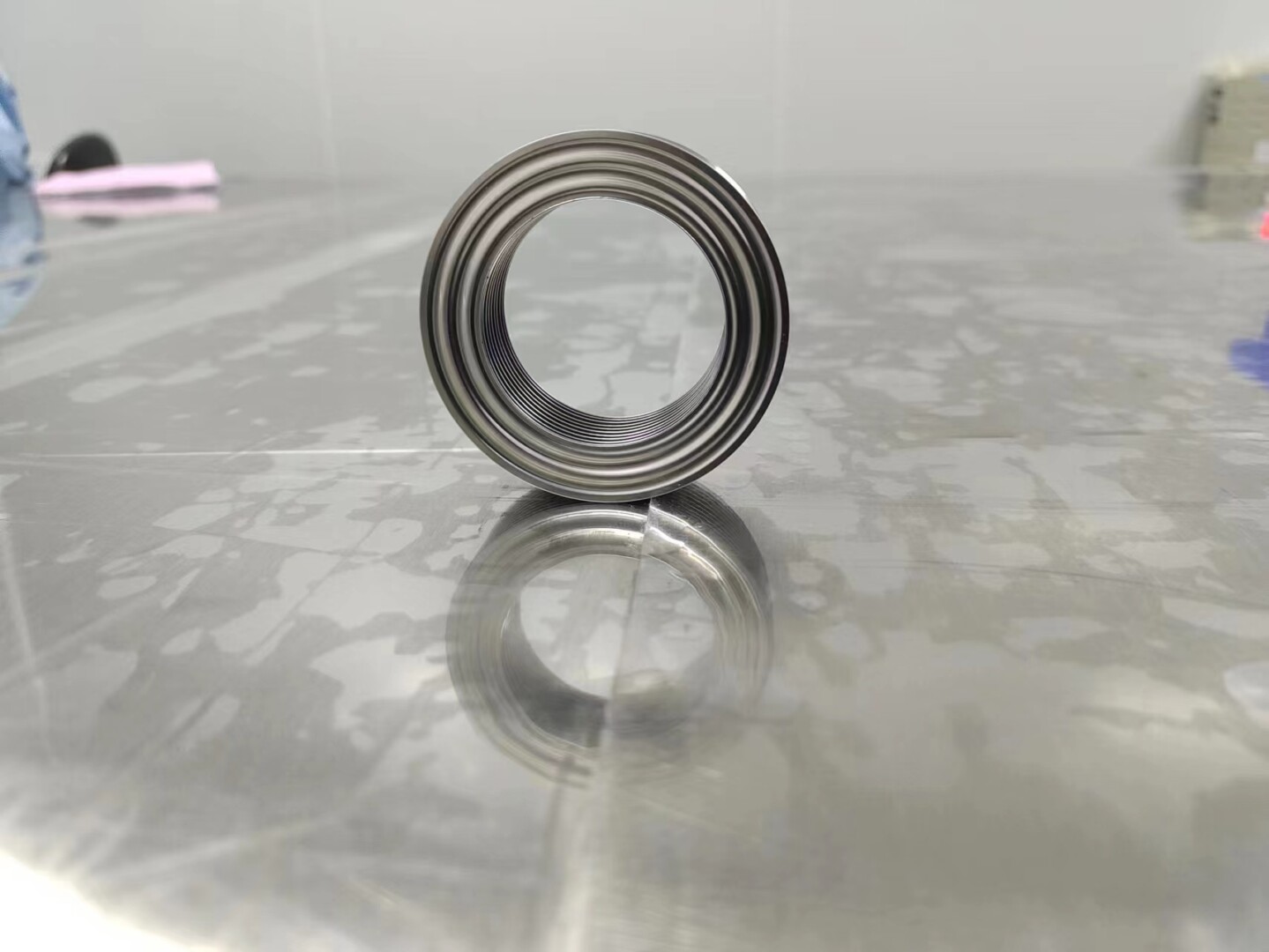
Porous transport layers (PTLs) and flow-field meshes are coated in vacuum sputter or evaporation systems, with large-area uniformity and adhesion that wet-coating cannot match. Every coating chamber is a vacuum system with feedthroughs, shutters and edge welded bellows-sealed mechanisms.
The Vacuum Coating Toolchain for Electrolyzers
- In-line sputter systems: continuous coating of plates and meshes, with load locks and roll-to-roll or plate-to-plate handling; large chambers mean long-stroke bellows for shutters and stages.
- Evaporation systems: for specialty films and high-rate deposition; source and shutter mechanisms are bellows-sealed.
- Plasma cleaning and pre-treatment: adhesion-critical, done in vacuum or atmosphere prior to coating.
- Metrology and leak testing: every chamber qualified with 100% helium leak testing per our leak testing guide.
Economics Drive the Adoption
Electrolyzer cost targets are unforgiving: the industry aims to cut stack cost several-fold to make green hydrogen competitive with grey. Vacuum coating attacks cost on two fronts — enabling cheaper substrate materials (coated stainless instead of titanium or gold-plated parts) and reducing precious metal loading. Analysts expect electrolyzer manufacturing capacity to grow by gigawatts per year through 2030, and every gigawatt of PEM capacity consumes multiple large PVD coating systems.
The Electrolyzer Cost Curve
Hydrogen project announcements keep compounding: electrolyzer gigafactories are planned or under construction in Europe, the US, China and the Middle East, and the largest announced PEM factories target multi-gigawatt annual capacity. Each gigawatt of PEM capacity is roughly thousands of bipolar plates and hundreds of thousands of coated parts per year — a volume that wet-coating processes cannot sustain reliably, which is why the coating industry is converting lines to vacuum sputtering. Vacuum component suppliers benefit twice: in the coating machines themselves, and in the quality assurance systems (leak testing, cleanliness) that every hydrogen component must pass. The qualification discipline mirrors what we describe for helium leak testing in fabs.
What Equipment Builders Need From Vacuum Suppliers
- Reliability at industrial scale: coating lines run continuously; bellows and valves must survive millions of cycles.
- Large-area uniformity: coating 0.5-1 m plates requires long-stroke, low-spring-rate bellows — the design discipline in our design guide.
- Clean, low-outgassing hardware: film quality depends on chamber cleanliness; the material guide explains alloy selection.
- Cost per cycle: energy-sector economics reward components with the best lifetime-per-dollar; fatigue engineering matters.
The Parallel to Other Coating Markets
Electrolyzer coating is one node in a fast-growing vacuum coating economy: the same PVD systems serve battery electrodes, fuel cells, optical films and the display supply chain. The tooling requirements are similar — and so is the component demand, as we described for vacuum-deposited perovskite solar and glass substrate metallization. Suppliers who serve one of these segments can serve all of them.
Alpha Technology for Hydrogen and Coating Systems
Alpha Technology supplies custom edge welded bellows, vacuum feedthroughs and formed bellows for PVD coating, plasma treatment and electrolyzer production systems — cleanroom assembled, leak tested, engineered for high-cycle industrial service. Contact our engineering team with your chamber size and duty cycle.
FAQ
Why is PVD coating important for green hydrogen?
PVD coatings protect electrolyzer bipolar plates from corrosion and cut precious-metal loading in electrodes — two of the biggest cost and durability barriers to electrolyzer scale-up.
What did FCVC 2026 highlight?
Impact Coatings won the Most Popular Exhibit Award at FCVC 2026 for PEM water electrolysis coating solutions, spotlighting vacuum coating in the hydrogen value chain.
What vacuum processes do electrolyzer fabs use?
Sputter coating of plates and meshes, evaporation for specialty films, plasma pre-treatment and leak-tested coating chambers — a full vacuum toolchain.
How does vacuum coating reduce cost?
Coated stainless substitutes for expensive alloys, and thin conformal PVD films cut iridium and platinum loading per megawatt — both cutting stack cost.
Building electrolyzer or coating lines? Contact Alpha Technology for vacuum components qualified for continuous industrial service.