
On August 19, 2026, IBM announced it had connected and cooled its first two modular cryogenic cells, reaching below 15 millikelvin — roughly 180 times colder than deep space. The milestone, part of IBM’s plan to link hundreds of quantum processors into one system, marks a structural change in quantum hardware: instead of one large cylindrical dilution refrigerator per machine, IBM’s cells are box-shaped enclosures built from solid aluminum, each offering about 0.53 square meters of wiring area, designed to be bolted together and cooled as a unit.
Most coverage focused on the qubits. But for vacuum engineers, the announcement quietly describes something else: a machine architecture where the number of vacuum envelopes, wiring penetrations and cryogenic interconnects scales almost linearly with compute capacity. Every added cell is another pressure boundary, another set of flanges, and dozens more vacuum feedthroughs.
What IBM Actually Built
The modular cryogenic cells keep the established dilution refrigerator principle — a helium-3/helium-4 mixture provides cooling below 10 mK — but replace the cylindrical fridge with a rectangular, solid-aluminum enclosure. The shape change is deliberate: a box leaves more usable wall area for wiring and signal lines than a cylinder of equivalent volume. IBM’s published cell specifications cite 0.53 m² of wiring area per cell, and the company demonstrated that a joined two-cell assembly cools from room temperature to 4 kelvin in a single rapid cooldown cycle.
The architecture exists for one reason: scaling. Linking hundreds of quantum chips means linking hundreds of cold spaces, each with its own vacuum-tight boundary, each penetrated by control wiring, microwave lines, thermometry and cryogenic plumbing. The dilution refrigerator stops being an instrument and becomes a — literally — mass-produced module.
Why Modularity Multiplies Vacuum Hardware
From one envelope to many
A conventional cryostat is a single vacuum space: one outer vacuum chamber (the insulating vacuum), one set of ports, one feedthrough budget. A modular array turns that into N interconnected envelopes. Every interface between cells — mechanical, thermal and electrical — becomes a potential leak path that must be designed, sealed and leak-tested. The insulating vacuum in each cell must hold for years without regeneration, which pushes every weld joint and every feedthrough braze toward the quality standards described in our helium leak testing guide.
The feedthrough count problem
Wiring is the scarcest resource in cryogenic quantum systems, and IBM’s design explicitly optimizes wall area for it. A single modular cell can carry dozens of penetrations: DC and RF signal lines, coaxial lines for microwave control, thermometry channels, heater power, and gas lines for the dilution circuit. Multiply by hundreds of cells and the feedthrough count of one large quantum system reaches into the tens of thousands. At that scale, feedthroughs stop being exotic parts and become catalog components — specified by leak rate, thermal conductivity and bake-out tolerance, in volume.
Bellows at every cold boundary
Cryogenic interconnects move between 300 K and 15 mK — a thermal contraction of roughly 0.3% in stainless steel, and more across long assemblies. Rigid piping across that gradient accumulates stress with every cooldown cycle. This is exactly the problem edge welded bellows exist to solve: absorbing axial and angular displacement across thousands of thermal cycles while remaining leak-tight, with documented fatigue life for the temperature range covered in our 4K-to-300K cryogenic cycling guide. Bellows also isolate the vibration of pulse-tube coolers and pumping lines from structures where nanometer-scale motion matters — a familiar requirement from dilution refrigerator vacuum hardware.
What It Means for Component Suppliers
IBM’s roadmap — modular cells shipping as products, linked into larger systems this decade — is one more signal that quantum computing is becoming a volume market for precision vacuum components. The sector’s requirement profile is distinctive: UHV-grade leak integrity, materials with low outgassing and low magnetic permeability, tolerance of hundreds of thermal cycles, and reproducible performance in series production. That combination is rare, and it is why quantum programs source bellows, feedthroughs and sealed assemblies from manufacturers with documented process control rather than general metalwork shops.
The Alpha Technology Angle
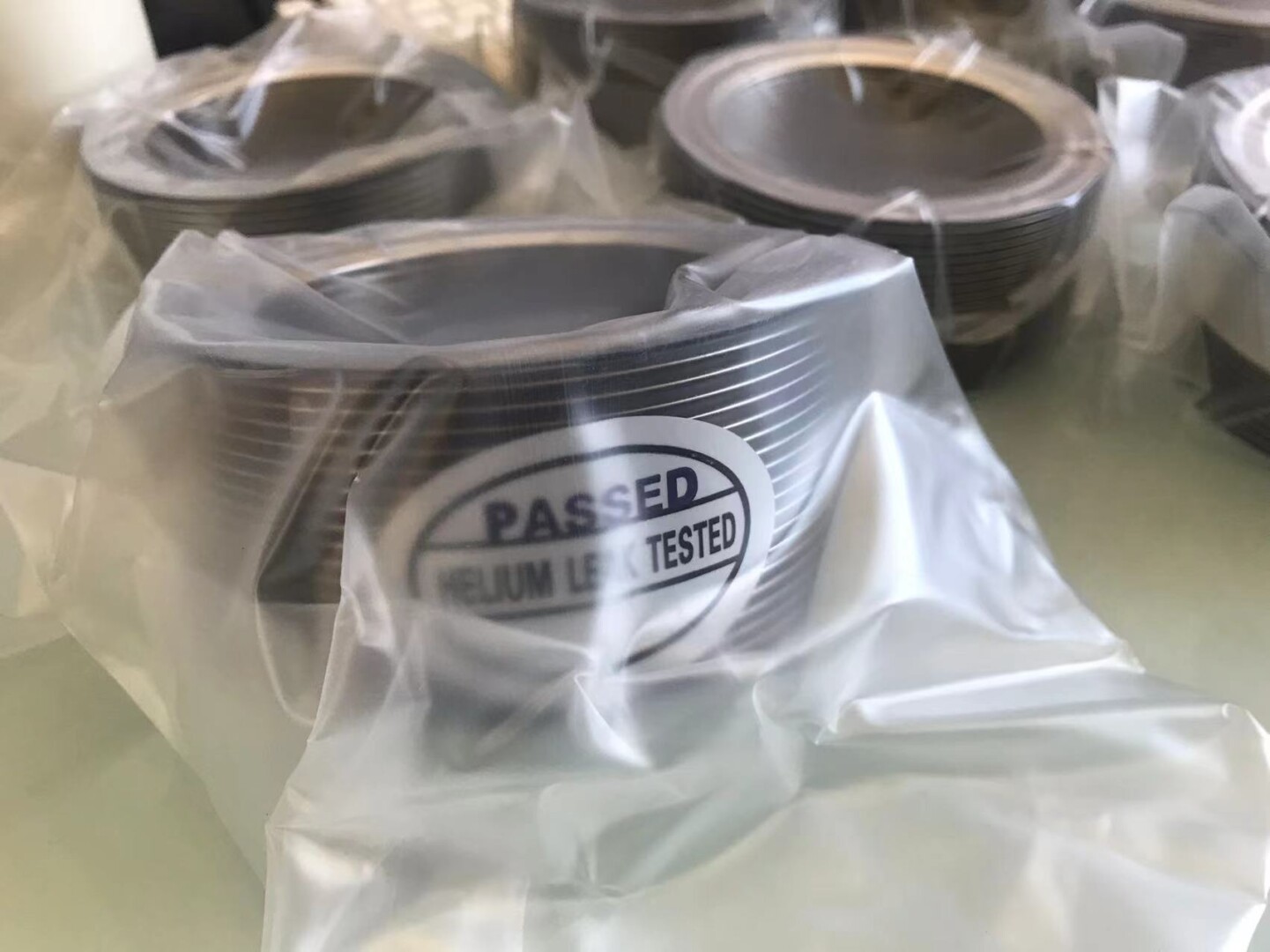
Alpha Technology manufactures custom edge welded bellows, vacuum feedthroughs and sealed weld assemblies for cryogenic and UHV systems — helium-leak-tested before shipment, with material certifications and cycle-life documentation. For modular cryostat, probe station or dilution refrigerator programs, contact our engineering team with your interface drawings.
FAQ
What did IBM announce in August 2026?
IBM connected and cooled its first two modular cryogenic cells to below 15 millikelvin — about 180 times colder than deep space — a step toward linking hundreds of quantum processors in modular, box-shaped cryostats.
Why do cryostats need vacuum feedthroughs?
Every signal, power line and gas line entering a cryostat must cross the insulating vacuum boundary. Feedthroughs carry these lines through the wall while maintaining leak-tight integrity at UHV pressures.
Why are bellows used in cryogenic systems?
Edge welded bellows absorb thermal contraction between room-temperature and millikelvin stages, isolate pump and cooler vibration, and survive thousands of thermal cycles without leaking.
How cold is 15 millikelvin?
15 mK is 0.015 degrees above absolute zero — about 180 times colder than the cosmic microwave background of deep space.
Specifying vacuum hardware for a cryostat or quantum system? Contact Alpha Technology for leak-tested, documented bellows and feedthroughs.