
On August 27, 2026, IBA (Ion Beam Applications) reported first-half results in which proton therapy drove a 66% jump in EBIT, with revenue up 6% to €323.7 million and the proton therapy division swinging to positive margins. Days earlier, Russian media reported that the country’s first domestically built superconducting particle accelerator for cancer treatment — the MSC-230, designed to enable ultra-high-dose-rate “flash” therapy — is on track for completion in 2027. And in early September, Barcelona’s Hospital Clínic rolled out a new-generation proton therapy service for cancer patients.
Proton therapy is scaling from a boutique treatment to a mainstream modality — more than a hundred centers now operate worldwide, and equipment makers from IBA and Varian to Mevion and Hitachi are adding capacity. Here is what the market reports rarely say: every proton therapy center is, at heart, a vacuum machine. The accelerator, the beamlines that steer protons to the treatment room, and the rotating gantries that aim them at the patient all run in vacuum. This article looks at the vacuum systems inside medical particle accelerators — and why they are the reliability backbone of the treatment.
How a Proton Therapy Center Works
A proton center has three major vacuum domains:
The accelerator
Protons are born in an ion source and accelerated to therapeutic energies — typically 230–250 MeV. Two architectures dominate: synchrotrons (IBA’s classic design) and cyclotrons, increasingly superconducting cyclotrons that shrink the magnet footprint. The beam accelerates and circulates inside an ultra-high-vacuum chamber, typically 10-7 to 10-9 mbar, because even trace gas would strip or scatter the beam and activate the machine.
The beam transport lines
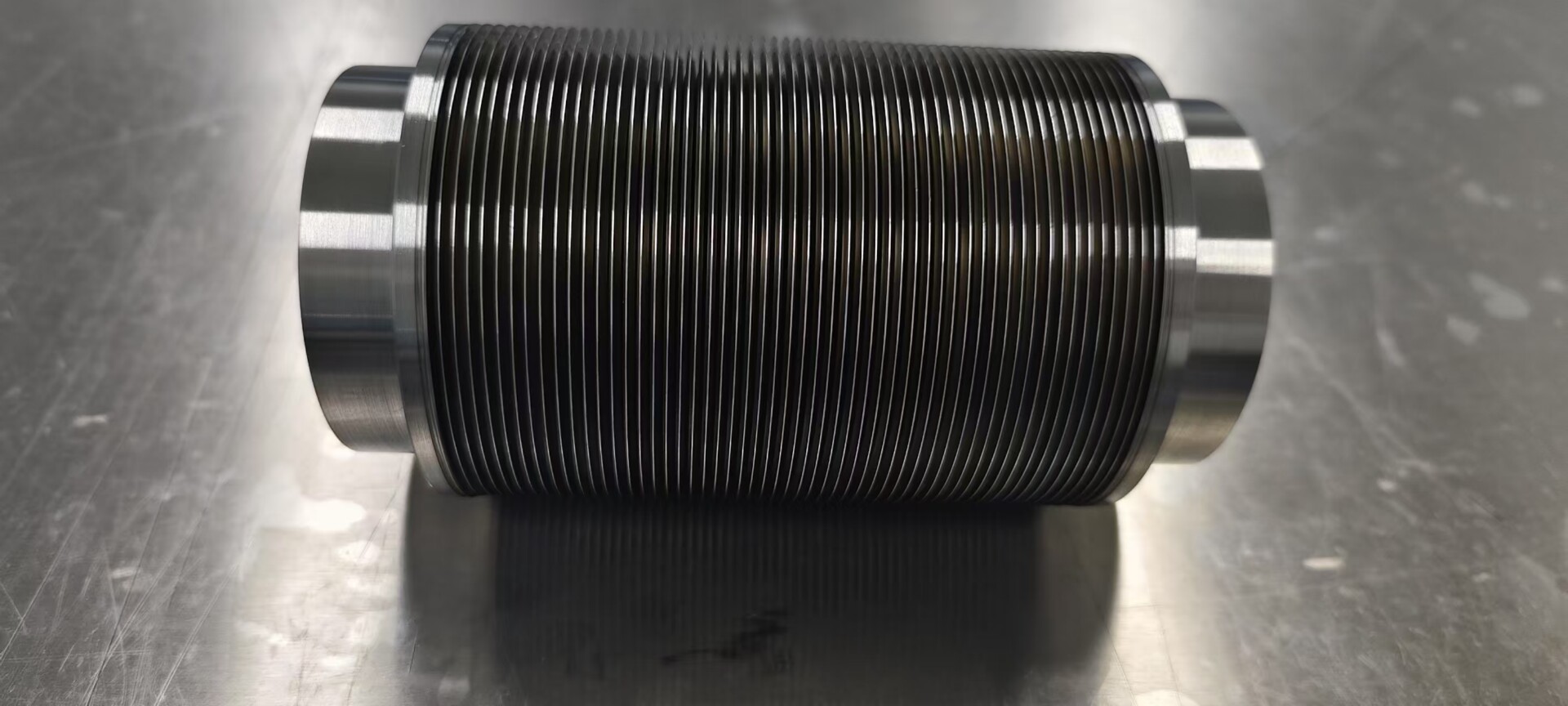
From the accelerator, the beam travels through a network of evacuated beam pipes to each treatment room. These lines thread through steel shielding walls, across rotating gantry bearings and along temperature-controlled galleries. Edge welded bellows at every flange join absorb misalignment, vibration from magnets and vacuum pumps, and thermal movement — while keeping the line leak-tight. Where the beam crosses from the fixed line into the rotating gantry, bellows and rotary vacuum joints take the brunt of continuous motion.
The nozzle and beam window
At the treatment nozzle, protons must leave vacuum and enter air to reach the patient. The beam exits through a thin metal window — and upstream of it, scanning magnets and dose monitors operate in vacuum, with feedthroughs carrying power and signals through the wall. The nozzle is the most safety-critical vacuum zone in the building: a window failure stops treatment, and a vacuum fault in the middle of a patient session is a clinical event, not just a maintenance nuisance.
Why Medical Accelerators Are Demanding Customers
Medical accelerators combine research-grade vacuum requirements with clinical operating constraints:
- Availability — a proton center treats 60–80 patients a day; downtime is measured in lost treatments and deferred revenue. Components must be reliable and serviceable fast.
- Radiation environment — everything near the beamline lives in a radiation field that degrades elastomers and electronics. All-metal bellows and metal-sealed joints dominate, the same discipline we apply to UHV semiconductor components.
- Cycle life — gantries rotate continuously between patients; bellows and seals in the motion path must survive hundreds of thousands of cycles, the fatigue-engineering territory of our bellows design guide.
- Compactness — superconducting cyclotrons and single-room systems pack accelerators into smaller footprints, tightening space for vacuum hardware and favoring welded, low-profile bellows assemblies.
Flash Therapy Raises the Bar
The MSC-230 project and broader flash-therapy research aim to deliver the full treatment dose in milliseconds rather than minutes, exploiting ultra-high dose rates to spare healthy tissue. Flash beams are pulsed and intense, which stresses the vacuum envelope differently: more beam loss near windows and targets, higher thermal transients, and greater demand for fast vacuum recovery if a vent occurs. The vacuum hardware trend in flash machines is the same as in the rest of the field — more all-metal components, tighter leak rates, more robust thermal design — but each spec moves up a notch.
The Market Signal for Component Suppliers
IBA’s H1 performance — equipment sales up, margins positive, guidance reaffirmed — plus new center openings and the MSC-230 program point one direction: more accelerators, more beamlines, more nozzles. Each new center is a multi-year consumption of UHV hardware: accelerator vacuum chambers, beamline bellows by the dozen, gate and isolation valves, feedthroughs for magnets, scanners and monitors, and helium leak-check services during commissioning and every maintenance campaign. The vacuum supply chain for proton therapy is small today, but it grows with every center that opens — and the reliability bar (medical uptime) is higher than in almost any research application.
The Alpha Technology Angle
Alpha Technology supplies custom edge welded bellows, bellows-sealed valve assemblies and vacuum feedthroughs for medical accelerator and beamline systems — UHV-rated, radiation-tolerant, helium-leak-tested with cycle documentation. Accelerator OEMs and proton center engineering teams can contact our engineering team with their vacuum system drawings.
FAQ
Why does a proton therapy machine need vacuum?
Protons must accelerate and travel to the patient in vacuum — typically 10-7 to 10-9 mbar — because gas molecules would scatter the beam and activate machine components.
How big is the proton therapy market?
IBA, the market leader, reported H1 2026 revenue of €323.7 million (+6%) with EBIT up 66%, driven by proton therapy, as more than 100 centers operate worldwide and single-room systems lower entry cost.
What vacuum components does a proton center need?
Accelerator vacuum chambers, beamline bellows at every flange, gantry rotary joints, gate valves, feedthroughs and beam windows — mostly all-metal, radiation-tolerant, leak-tested designs.
What is flash proton therapy?
An ultra-high-dose-rate delivery method that gives the full dose in milliseconds, sparing healthy tissue. It demands more robust vacuum hardware near beam windows and targets.
Building or upgrading a proton therapy center? Contact Alpha Technology for UHV bellows, valves and feedthroughs for medical accelerators.