
On July 13, 2026, Fortune Business Insights valued the global cryo-electron microscopy (cryo-EM) market at roughly $1.75 billion for 2026, with forecasts reaching $4.25–6.5 billion by the mid-2030s at an 11–12% CAGR. A month later, on August 12, 2026, GlobeNewswire sized the European cryo-EM market alone at $0.41 billion, while Coherent Market Insights projects the global figure to grow from $1.63 billion in 2026 to $3.62 billion by 2033 at 12.1% CAGR. Every one of those dollars buys an instrument whose resolving power is set by one discipline above all others: ultra-high vacuum (UHV) engineering.
A cryo-EM instrument is not a camera with a lens. It is a 300 kV electron accelerator, a cryogenic sample stage and a detector, joined by a column that must stay cleaner than the inside of most space hardware. The reason is physics: electrons scatter off any residual gas molecule, blurring the image; ice grows on cold surfaces unless water partial pressure is driven below detectable limits; and a single contamination event can ruin a dataset that took weeks of sample preparation to collect.
Why Vacuum Is the Microscope
Column vacuum: the resolution budget
Flagship systems such as Thermo Fisher Scientific’s Titan Krios operate their electron columns at pressures near 10-8 to 10-9 mbar — the same regime as the UHV components used in semiconductor fabs. At these pressures the mean free path of an electron is long enough that beam interactions with background gas become negligible. Every vacuum joint, every flange, every feedthrough along the column is therefore a resolution decision.
The cryogenic sample environment
Samples are plunge-frozen in liquid ethane and held at liquid nitrogen temperature (−196 °C) during imaging. Cold surfaces act as cryopumps: residual water vapour migrates toward the sample and freezes onto it unless the surrounding vacuum is aggressively clean. That is why cryo-EM instruments spend as much engineering effort on vacuum hygiene as on optics.
Load locks: the gate between atmosphere and column
Every sample exchange cycles the specimen through a load lock and transfer system — a small, separately pumped vestibule that protects the main column from venting. The transfer mechanisms rely on the same building blocks as any precision vacuum motion system: vacuum feedthroughs, bellows-sealed translators and gate valves, all helium-leak-tested to UHV standards (see our helium leak testing guide).
The Vacuum Hardware Stack Inside a Cryo-EM
- Ion pumps and cryopumps maintain base pressure; turbo pumps handle roughing and regeneration cycles.
- Gate and slit valves isolate the column from the sample chamber and detector stages.
- Feedthroughs carry high voltage, thermocouple signals and motion into the vacuum envelope — the electrical and mechanical port count of a modern cryo-EM runs into the dozens.
- Bellows absorb thermal contraction of cryogenic lines, isolate pump vibration and give the stage its nanometre-scale positioning stroke.
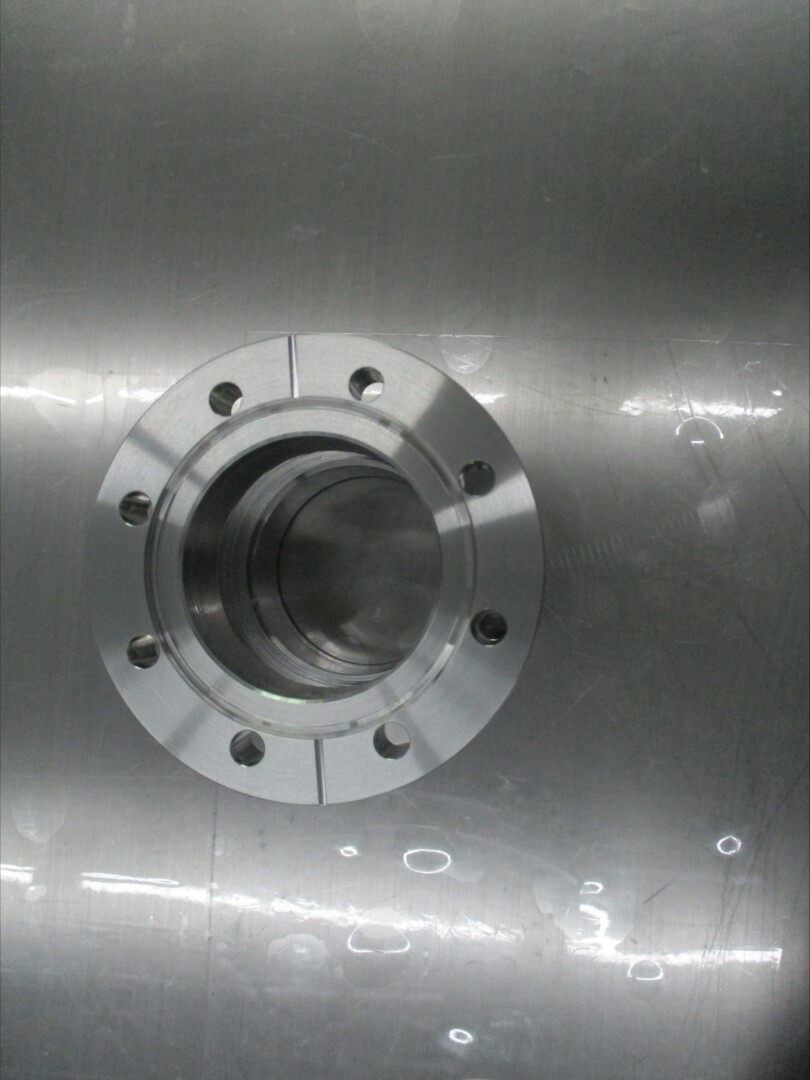
- Viewports let operators align the beam and monitor the stage.
These are not commodity parts. A feedthrough that leaks 1×10⁻¹⁰ mbar·L/s at the wrong weld ruins base pressure; a bellows with a weak spring rate disturbs a stage that must drift less than an Angstrom per minute. This is precisely the class of component Alpha Technology builds — from edge welded bellows with documented cycle life to multi-pin vacuum feedthroughs — each helium-leak-tested before shipment.
Why the Market Is Growing Now
The 2026–2030 growth cycle is driven by four forces: (1) AI-enabled automated grid screening, which turns cryo-EM from a research instrument into a throughput tool; (2) structure-based drug design, where pharmaceutical companies map viral proteins and membrane targets at atomic resolution; (3) national microscopy infrastructure programs across Europe, North America and Asia, evidenced by the $0.41B European equipment market; and (4) the push toward benchtop and mid-voltage instruments, which lowers the barrier to entry but still demands genuine UHV performance.
For component suppliers, the consequence is a growing installed base of columns that must be serviced, upgraded and replicated. Every new instrument and every service cycle consumes the same vacuum hardware — a long-tail demand that tracks the market’s 11–12% CAGR.
The Alpha Technology Angle
Alpha Technology supplies custom edge welded bellows, vacuum feedthroughs and sealed assemblies for UHV instruments, semiconductor tools and scientific facilities — including the cryogenic service conditions found in 4K-to-300K thermal cycling. Every part ships with material certifications and helium leak test records. Contact our engineering team with your column or chamber drawing for a qualification review.
FAQ
Why does a cryo-EM need ultra-high vacuum?
Residual gas scatters the electron beam and blurs the image; water vapour freezes onto cryogenic samples. UHV below 10-8 mbar minimizes both effects and keeps the column clean for atomic-resolution imaging.
How big is the cryo-EM market?
Fortune Business Insights values it at about $1.75 billion in 2026, growing to $4.25–6.5 billion by the mid-2030s at an 11–12% CAGR; Coherent Market Insights projects 12.1% CAGR to $3.62 billion by 2033.
What vacuum components does a cryo-EM use?
Ion and cryopumps, gate valves, high-voltage and signal feedthroughs, bellows-sealed translators, viewports and load-lock systems — all helium-leak-tested to UHV standards.
How is sample contamination prevented?
Through aggressive vacuum hygiene: clean UHV base pressure, cryogenic cold traps, controlled load-lock transfer, and components that outgas minimally, including feedthroughs and bellows with documented leak rates.
Specifying vacuum hardware for a cryo-EM or UHV instrument? Contact Alpha Technology for leak-tested, documented components.