
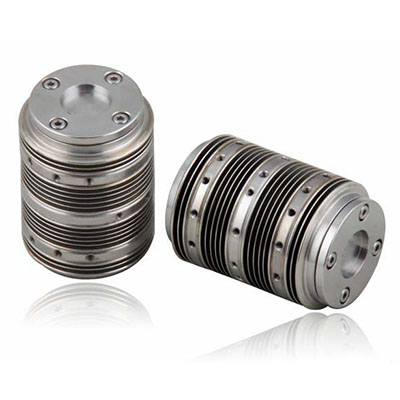
In mid-2026, SNS Insider sized the global expansion joints market at $1,285 million for 2026, growing on the back of hydrogen pipeline build-out valued above $1.2 billion — while the IEA’s Global Hydrogen Review 2026 documented a fast-expanding trade in hydrogen infrastructure that places unprecedented demands on piping flexibility and leak integrity. Google Trends confirms the engineering attention: “bellows expansion joint” has held steady search volume worldwide for 12 consecutive months, making it one of the most durable bellows queries in the market. If you are piping anything that moves, heats or cools — process gas, steam, cryogen or hydrogen — the metal bellows expansion joint is the component that keeps the line intact.
An expansion joint is not a decorative flex connector. It is a precision pressure vessel whose entire job is to absorb movement that would otherwise overstress the pipe — and getting its specification wrong is how lines crack, flanges leak and plants shut down.
The Three Movements an Expansion Joint Absorbs
1. Axial movement (extension and compression)
Thermal growth along the pipe axis is the most common duty. The joint’s convolutions compress and extend as the line heats and cools, keeping the anchor points stationary. Axial stiffness and stroke capacity are governed by bellows geometry — the trade-offs are covered in our bellows design guide.
2. Lateral (transverse) movement
When a pipe changes direction or anchors offset, the joint must absorb shear-like lateral displacement. Multi-convolution edge welded bellows handle lateral movement efficiently because each convolution contributes to bending compliance — a key reason welded joints are specified where formed bellows cannot fit.
3. Angular rotation
Piping misalignment and equipment settlement produce angular rotation at flanges. Angular capability is a function of convolution count and pitch; a correctly designed joint absorbs angular deflection without imposing bending stress on the pipe walls.
Most real installations combine all three. The spec must state each value explicitly — “20 mm axial, 5 mm lateral, 2° angular” — because an unspecified movement will still occur, just at the wrong component.
Pressure, Temperature and the Hydrogen Question
Expansion joints are pressure vessels: the bellows wall carries the full system pressure, and design pressure plus test pressure plus fatigue life are the governing inputs. Material selection follows the medium — 316L for general process, AM350 for high strength, Inconel 718 for elevated temperature and corrosion. The hydrogen economy adds two specific disciplines: hydrogen embrittlement resistance (which pushes toward austenitic and nickel alloys rather than carbon steel) and zero-leakage certification, since hydrogen’s small molecules escape seals that pass larger gases. Every joint for hydrogen service should ship with helium leak test documentation and material certificates.
Cycle Life Is a Specification, Not a Hope
An expansion joint that absorbs movement is, by definition, fatiguing itself. Industry practice — and the custom bellows specification routine we recommend — is to state a required number of full-stroke cycles at design pressure, then design the convolutions for a fatigue life several times higher. Welded bellows excel here: because edge welding produces thin, uniform convolutions with no thinning at the crest (unlike formed bellows), fatigue life is predictable and documented. The math is the same family of equations used for accelerator and cryogenic service — where a failed joint means a multi-week outage.
Installation Rules That Keep Joints Alive
- Anchors and guides: expansion joints must be installed with proper main anchors and pipe guides so the movement reaches the joint rather than the flange.
- Pre-extension or compression: install at the specified cold setting so the joint reaches its neutral position at operating temperature.
- Protection: external bellows shields for insulation, internal sleeves where flow erosion is possible, and cleanout ports where debris can settle.
- Testing: proof test at 1.5× design pressure and helium leak test to the agreed rate before installation.
Alpha Technology for Expansion Joint OEMs and Plants
Alpha Technology manufactures custom edge welded bellows and complete expansion joint assemblies for process, cryogenic and hydrogen service — 316L, AM350 and Inconel 718, with fatigue life calculations, 1.5× proof testing and 100% helium leak testing with serialized documentation. Contact our engineering team with your movement, pressure, temperature and cycle requirements.
FAQ
What is a metal bellows expansion joint?
A flexible pipe component built from a welded metal bellows that absorbs axial, lateral and angular movement caused by thermal growth, pressure or misalignment without leaking.
What movements must I specify?
Axial extension/compression, lateral displacement and angular rotation — usually in combination, each stated explicitly for the design condition.
Why are welded bellows preferred for expansion joints?
Edge welded convolutions have uniform wall thickness and no crest thinning, giving predictable fatigue life, compact envelopes and high cycle counts.
How big is the expansion joint market?
SNS Insider sizes it at $1,285 million for 2026, with hydrogen pipeline infrastructure above $1.2 billion driving demand for high-integrity welded joints.
Specifying an expansion joint for a critical line? Contact Alpha Technology with your movement and pressure data.