
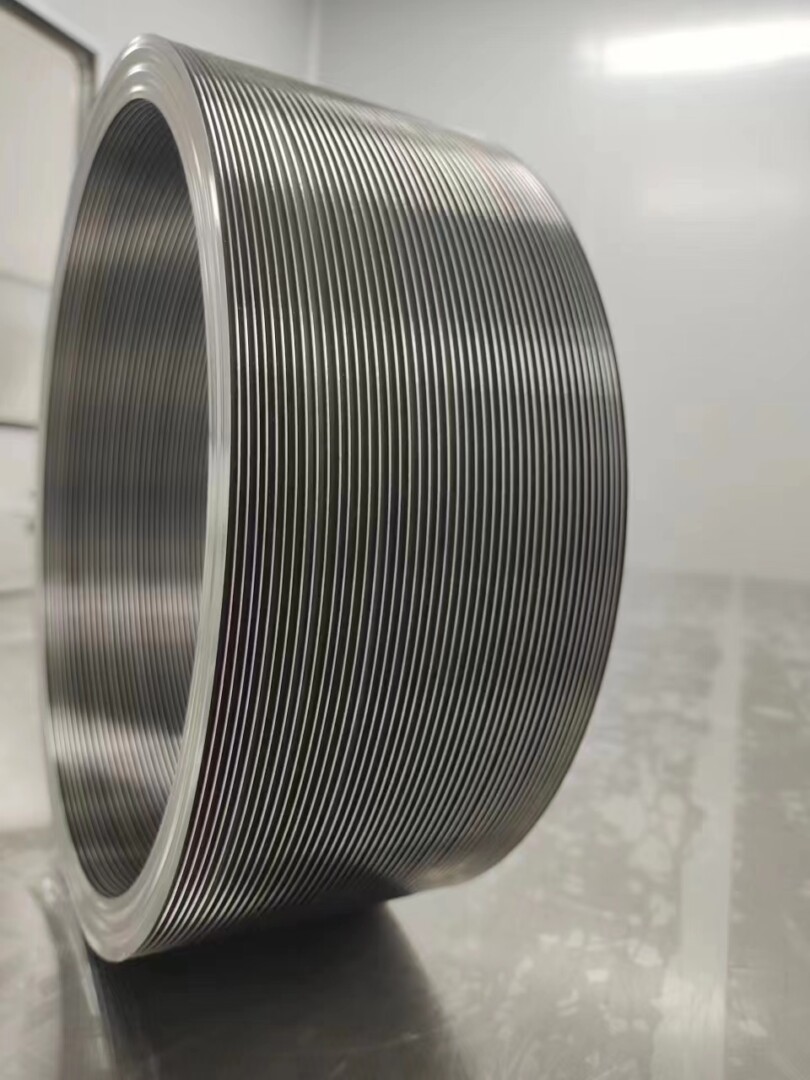
On August 7, 2026, HD Hyundai completed the last of the nine vacuum vessel sectors for ITER, closing out one of the largest precision-fabrication programs in industrial history — a 7-nation effort whose welded, 500-tonne-grade stainless sectors must hold a burning plasma at 10-7 mbar. Days earlier, a British team filed a patent for a fusion reactor designed to come apart in rings, bolted rather than welded, explicitly to make maintenance practical. Between those two headlines sits the quiet engineering reality of fusion: whatever the vessel architecture, every port, diagnostic, fuel line and service module crosses the vacuum boundary on edge welded bellows.
Fusion machines are not built to be opened; they are built to be serviced through their ports — and ports are where bellows live.
From Welded Sectors to Serviceable Ports
ITER’s vacuum vessel is welded for a reason: the first wall must survive neutron fluxes, 10 MW/m² heat loads and decades of operation. But the machine is still serviced — remotely, under hot-cell conditions, through hundreds of ports: equatorial ports for heating and diagnostics, upper ports for maintenance robots, lower ports for pumping and fueling. Every one of those ports carries bellows, gate valves and feedthroughs that isolate the vessel during maintenance and absorb thermal expansion between the vessel and the surrounding cryostat. We described the sector-installation milestone in our earlier ITER vacuum vessel engineering analysis; this article looks at what happens inside those ports for the life of the machine.
Where Bellows Do the Work in a Tokamak
1. Port and service bellows
Vessel ports expand and contract with temperature swings between bake-out (200–300°C), plasma operation and cool-down. Edge welded bellows in the port assemblies absorb that differential motion while holding UHV. They are also the flexible link that lets remote maintenance tools dock without stressing vessel welds.
2. Bellows-sealed valves for fueling and pumping
Tritium fueling lines and cryopump isolation rely on all-metal bellows-sealed valves — elastomers are impossible in a radiation and tritium environment. The valve bellows discipline is identical to the one analyzed in our slit valve and gate valve guide, scaled up and hardened for neutron and tritium service.
3. Diagnostic and heating feedthroughs
Each diagnostic port needs electrical, optical and water-cooling crossings through the vacuum boundary. Bellows-integrated vacuum feedthroughs carry the signals and the coolant while flexing with the port. For cryogenic diagnostics, the thermal-cycling discipline from our cryogenic bellows guide applies directly.
What Makes Fusion Bellows Different
Fusion bellows are not simply scaled-up fab components. They are larger — port bellows can exceed 500 mm in diameter — and they must survive neutron irradiation, tritium permeation and repeated bake-outs to 300°C. Materials skew toward Inconel 625/718 and high-strength AM350 rather than standard 316L, and every weld is radiographed and helium leak tested. Wall thicknesses are tuned for pressure and fatigue rather than stroke economy, which is why custom engineering — not catalogue selection — defines the fusion supply chain. The custom bellows specification guide lists the ten parameters fusion buyers must define before quoting.
The Serviceability Revolution
The British patent filed in July 2026 for a ring-segment reactor that unbolts one module at a time is the clearest signal yet that the industry is moving from “seal it forever” to “seal it, then open it on schedule.” That shift multiplies the demand for reliable, re-connectable vacuum interfaces: bolted flanges sealed with metal gaskets, bellows that survive repeated compression, and vacuum gaskets that hold after dozens of thermal cycles. The same philosophy drives the private fusion fleet — CFS’s SPARC and TAE’s Da Vinci plant, both covered in our SPARC vacuum analysis and TAE plant analysis — where maintenance windows are budgeted like production downtime, not research events.
Testing Fusion-Grade Bellows
Fusion bellows must be traceable: material certifications, weld records, and leak test results archived per serial number, because a tritium-loop leak is a regulatory event, not a maintenance item. The acceptance standard is helium leak testing to 1×10⁻⁹ mbar·L/s or better, with thermal cycling validation per our leak testing guide. Alpha Technology applies the same serialized-documentation discipline to every fusion-qualified component it ships.
Alpha Technology for Fusion Ports and Service Modules
Alpha Technology supplies custom edge welded bellows, vacuum feedthroughs and vacuum gaskets for tokamak ports, diagnostic modules and fueling systems — radiation-tolerant alloys, 100% helium leak tested, documented per serial number. Contact our engineering team with your port envelope, temperature and maintenance-cycle requirements.
FAQ
Why does a fusion reactor need edge welded bellows?
Ports, valves and feedthroughs must cross the vacuum boundary while absorbing thermal expansion and surviving remote maintenance; welded metal bellows provide hermetic, radiation-tolerant flexibility.
What happened at ITER in August 2026?
HD Hyundai completed the final vacuum vessel sector on August 7, 2026, finishing the 9-sector, 7-nation fabrication program; six sectors were already installed in the tokamak pit.
Can fusion reactors be serviced?
Yes — through hundreds of equatorial, upper and lower ports using remote handling; a July 2026 British patent even proposes a ring-segment reactor that unbolts for maintenance.
What leak rate do fusion bellows need?
Fusion-grade bellows are typically accepted at 1×10⁻⁹ mbar·L/s or better, with serialized helium leak test documentation.
Engineering bellows for a fusion port or service module? Contact Alpha Technology with your radiation, temperature and cycle specifications.