
On August 13, 2026, VAT Group — the global leader in high-end vacuum valves — published its half-year results and reaffirmed its outlook for 2026, citing “solid momentum” from semiconductor equipment investment driven by AI processors and sub-2nm manufacturing. The same week, Google Trends data for the past 12 months showed “bellows valve” as the single most-searched bellows term worldwide, with the related query “bellows valve product” up 500% — engineers are not just looking for valves; they are comparing valve technologies and buying. If you are specifying isolation valves for a vacuum line, the first design decision is how the moving stem is sealed: bellows sealed or diaphragm.
The two designs look similar from the outside, but their leak physics, cycle life and cost profile diverge sharply — and the choice decides whether your UHV process stays clean for a million cycles or drifts on week one.
The Seal Designs, Side by Side
Diaphragm valves: elastomer-sealed simplicity
A diaphragm valve seals the stem with a flexible elastomer or metal diaphragm that moves with the actuator. In vacuum service the elastomer diaphragm is the classic low-cost solution: simple, compact and perfectly adequate for rough vacuum and vent lines. But the diaphragm is also the failure point — elastomers outgas, absorb moisture and shed wear particles, and their permeability becomes measurable below 1×10⁻⁶ mbar. Above that, or in bake-out service, elastomer diaphragms are disqualified by physics, not by price.
Bellows sealed valves: welded metal isolation
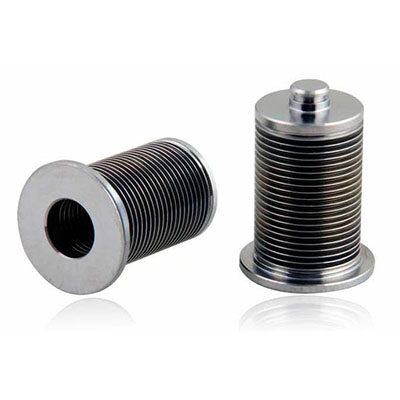
A bellows sealed valve replaces the flexible diaphragm with a welded metal bellows that encloses the stem completely. The bellows flexes with the stroke while the atmosphere is blocked by a solid metal wall — no sliding seal, no elastomer, no outgassing. Leak integrity is limited only by the bellows welds, which is why bellows valves dominate the UHV and semiconductor duty classes. The engineering trade-off is cost and envelope: welded bellows are precision components, specified per the logic of our custom bellows specification guide.
Decision Criteria for Vacuum Buyers
1. Target pressure decides everything
Below 1×10⁻⁶ mbar — which includes essentially all semiconductor process chambers, load locks and metrology tools — the choice is made for you: bellows sealed. At rough vacuum and vent duty, diaphragm valves remain cost-effective. Between the two, hybrid designs use a bellows stem seal with an elastomer face seal, balancing price and performance.
2. Cycle life and maintenance budget
Diaphragm valves typically require diaphragm replacement on a schedule; bellows sealed valves are specified for hundreds of thousands to millions of cycles with the fatigue life calculated up front. In a fab running valves millions of cycles per year, the lifetime cost of a bellows valve is usually lower than a diaphragm valve plus its maintenance labor — the same life-cycle math our design guide applies to every bellows assembly.
3. Particle and cleanliness requirements
Every stroke of an elastomer seal generates wear particles; every bellows stroke generates none. For defect-sensitive processes — advanced packaging, epitaxy, EUV — the particle budget alone eliminates diaphragm stem seals. The leak-test discipline that certifies bellows valves is documented in our helium leak testing guide.
4. Bake-out and thermal cycling
UHV systems are baked at 150–300°C to drive off water; elastomers cannot survive repeated bake-out, welded metal bellows can. The same property makes bellows valves the standard in accelerator beam lines and fusion machines.
Where Each Design Wins
- Bellows sealed wins: UHV and HV process chambers, load locks, slit and gate valves, gas panels, accelerators, anything baked or particle-sensitive.
- Diaphragm wins: rough vacuum, pump isolation, vent lines, low-cycle utility service, cost-constrained systems above 10-6 mbar.
- Hybrid wins: medium vacuum with frequent cycling where a full metal seal is overkill.
Specifying a Bellows Sealed Valve
When you move to bellows sealed, define: (1) leak rate target (typically <1×10⁻⁹ mbar·L/s for UHV), (2) cycle life at full stroke, (3) bake-out temperature, (4) stem travel and actuation type, and (5) material grade — see our materials comparison for 316L vs AM350 vs Inconel. Alpha Technology supplies custom edge welded bellows and bellows-sealed stem assemblies to valve OEMs, with spring rate and fatigue life documented per lot.
FAQ
What is a bellows sealed valve?
A valve whose moving stem is enclosed by a welded metal bellows, creating a solid-metal barrier between atmosphere and vacuum with no sliding seal and no elastomer.
When should I choose a diaphragm valve instead?
At rough vacuum or vent duty above about 1×10⁻⁶ mbar, where the lower cost of elastomer diaphragms outweighs their outgassing and particle limits.
Why are bellows valves used in semiconductor fabs?
Process chambers need leak rates below 1×10⁻⁹ mbar·L/s, zero particles and bake-out tolerance — properties only welded metal bellows deliver reliably for millions of cycles.
Is the vacuum valve market growing?
Yes — VAT reaffirmed strong 2026 demand on AI-chip-driven fab investment and sub-2nm manufacturing in its August 13, 2026 half-year results.
Selecting valves for a vacuum or UHV line? Contact Alpha Technology with your pressure, cycle and leak requirements.