
On August 10, 2026, Fortune Business Insights sized the global atomic layer deposition (ALD) market at $3.45 billion in 2026, growing at a 12.5% CAGR to $8.84 billion by 2034; Precedence Research projects an even longer runway, from $3.18 billion in 2025 to $10.71 billion by 2035. The drivers are familiar: gate-all-around transistors, high-k gate dielectrics, DRAM capacitor liners, 3D NAND high-k fills, barrier layers in advanced packaging, and battery and display films.
ALD matters to vacuum engineers more than any other deposition technique because it is the most vacuum-exacting process in mass production. A single atomic layer per cycle means the reactor’s gas switching, pressure control and cleanliness decide whether the film grows one atom at a time — or fails. This article breaks down the vacuum hardware that makes ALD work, extending our coverage of UHV epitaxy and 3D memory vacuum processes.
How ALD Works (and Why It Needs Perfect Vacuum)
ALD grows films by alternating self-limiting surface reactions:
- Pulse A — precursor A flows into the chamber and reacts with the wafer surface until every active site is consumed — then stops, because the reaction is self-limiting.
- Purge — an inert gas (argon or nitrogen) sweeps excess precursor out.
- Pulse B — co-reactant B (often water, ozone or ammonia) converts the adsorbed layer into the target film — again one monolayer.
- Purge — sweep, repeat. Growth rate: roughly 0.1–1 Å per cycle.
Each cycle is seconds long; a 20 nm film needs hundreds of cycles. The reactor must switch gases with millisecond precision, hold pressure constant, and avoid any cross-contamination — a leaked precursor or a residual molecule ruins the monolayer-by-monolayer logic. That is why ALD chambers are vacuum systems first and film tools second.
The Vacuum Hardware Inside an ALD Tool
Precursor delivery and switching
ALD’s heart is the valve manifold. Precursors — some pyrophoric, some corrosive, some solid materials sublimated at temperature — are pulsed through fast-switching, bellows-sealed valves. Bellows sealing keeps elastomers away from reactive chemistry and delivers the millions-of-cycles life a production ALD tool demands. The trade-offs between bellows and diaphragm sealing are examined in our valve selection guide.
Chamber and pedestal motion
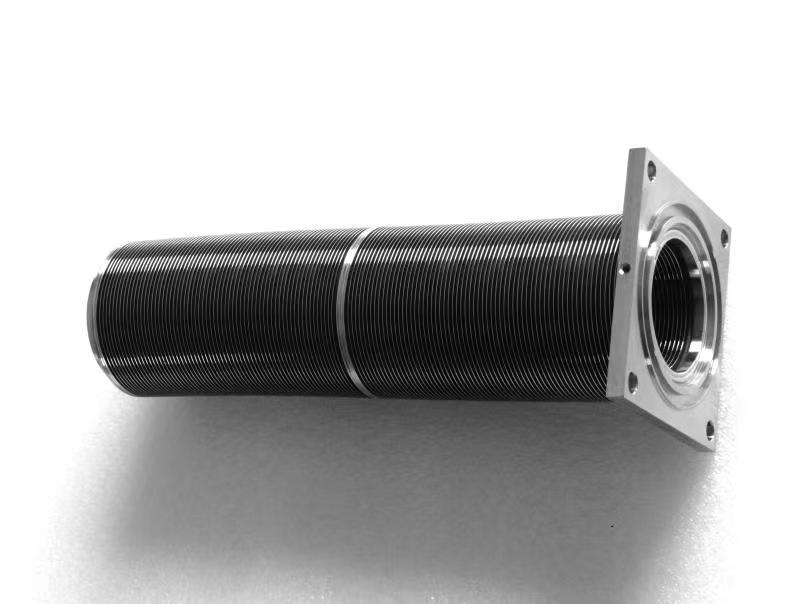
Wafers load and unload through slit valves; the heated pedestal lifts and lowers through bellows-sealed actuators. An edge welded bellows here must survive tens of thousands of hot cycles while keeping the process volume particle-free — the design discipline of our bellows design guide.
Pumping and pressure control
ALD runs at 1–10 mbar, but base pressures need to be excellent (10-6 mbar class) for repeatable purges. Turbopumps connect through vibration-isolating bellows; throttle valves control process pressure; forelines carry corrosive byproducts to abatement.
Temperature control hardware
Precursor canisters, lines and showerheads run at controlled temperatures — 100–300°C typically, higher for exotic precursors. Heater power and thermocouple feedback cross the wall through vacuum feedthroughs, with the thermal ratings covered in our high temperature feedthrough guide.
Leak integrity
A single micron-size leak in an ALD chamber contaminates hundreds of cycles. Production ALD tools are leak-tested to better than 1×10⁻⁹ mbar·L/s at every joint — the standards in our helium leak testing guide.
Why ALD Growth Means Component Growth
The 12.5% market CAGR understates the component intensity: ALD is adopted in more process steps every node — high-k/metal gates, DRAM capacitors, NAND charge traps, MRAM tunnel barriers, EUV underlayers, packaging barriers. Each new application adds chambers, and each chamber adds dozens of valves, feedthroughs, bellows and gaskets. Tool OEMs are scaling ALD chamber output faster than film revenue grows, because the same chamber count serves both R&D and production.
Selection Priorities for ALD Tool Builders
- Valve speed and repeatability — pulse timing is the process; valves must actuate identically for millions of cycles.
- Low outgassing, no particles — all-metal, bellows-sealed construction beats elastomers.
- Thermal stability — heated lines and chambers demand materials and joints rated for continuous elevated temperature.
- Documented leak rates and cycle life — every assembly shipped with test records, per the standards in our leak testing guide.
The Alpha Technology Angle
Alpha Technology manufactures custom edge welded bellows, bellows-sealed valve and actuator assemblies, vacuum feedthroughs and gaskets for ALD, PECVD and etch tools — helium-leak-tested, serialized and cycle-documented. ALD tool OEMs and process developers can contact our engineering team with their reactor drawings.
FAQ
What is atomic layer deposition?
ALD grows thin films one atomic layer at a time by alternating self-limiting precursor reactions with purge steps, enabling angstrom-level thickness control on the most demanding 3D structures.
Why is ALD a vacuum process?
ALD needs precise gas switching, controlled pressure and contamination-free environments — all properties of a well-built vacuum system — to achieve monolayer-per-cycle growth.
How big is the ALD market?
Fortune Business Insights values it at $3.45 billion in 2026, growing at 12.5% CAGR to $8.84 billion by 2034; Precedence Research projects $10.71 billion by 2035.
What vacuum hardware does an ALD tool need?
Fast bellows-sealed precursor valves, bellows-actuated pedestals, slit valves, pumping isolation bellows, heater feedthroughs and leak-tested seals throughout.
Developing or scaling ALD capability? Contact Alpha Technology for leak-tested bellows, valves and feedthroughs built for atomic-layer processes.