
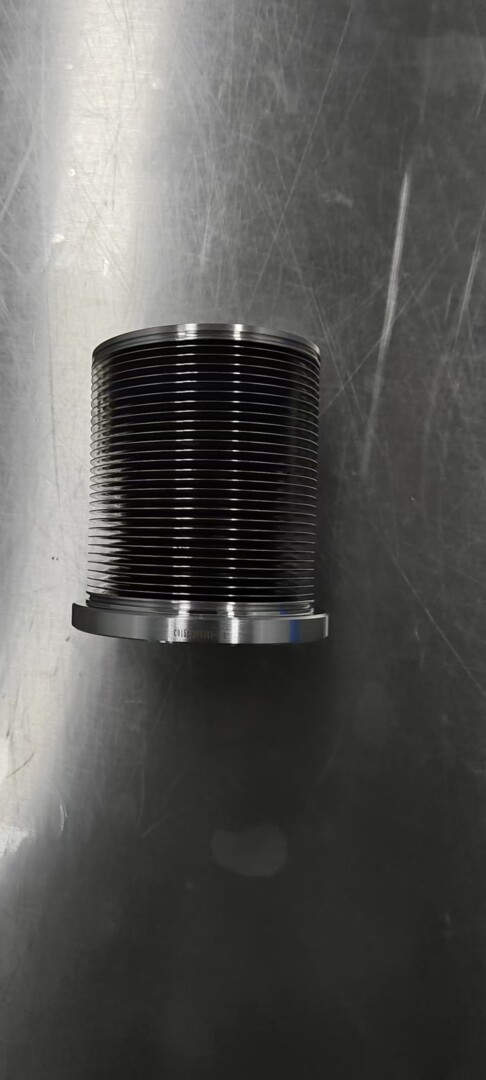
On August 24, 2026, a proof-of-principle experiment called P³ at the Paul Scherrer Institute (PSI) in Villigen, Switzerland produced its first positrons for CERN’s proposed Future Circular Collider (FCC) — using a magnet technology never before deployed inside a working particle accelerator: a 15-tesla solenoid built from high-temperature superconducting (HTS) ReBCO material. Reported on August 26, the milestone removes what physicists had called a potential engineering showstopper for FCC-ee, the electron–positron “Higgs factory” stage of the FCC program. Paolo Craievich, the PSI physicist co-leading the experiment, put it plainly: “These are the first positrons for the Future Circular Collider project, so it’s an important milestone.”
Why should vacuum engineers care? Because every particle collider is a vacuum machine, and the FCC will be the largest, most demanding one ever built — a ring more than 90 kilometers around whose beam pipes, radiofrequency cavities, magnets and detectors all operate in ultra-high vacuum. The P³ result is the latest reminder that accelerator physics and vacuum hardware advance together — the same story we told for the High-Luminosity LHC in our accelerator bellows analysis and for fourth-generation synchrotrons.
Why the Positron Source Was a Showstopper
FCC-ee will collide electrons and positrons at extraordinary rates to produce millions of Higgs bosons, W and Z bosons for precision measurement. Every collision rate target depends on filling the machine with positrons — and no existing positron source can deliver the intensity FCC-ee requires. Positrons are produced by firing a high-energy electron beam at a heavy-metal target: the beam creates a shower of particles in which electron–positron pairs are born. The engineering challenge is capture: freshly produced positrons spray out in all directions with wildly spread energies, and most are lost before they can be gathered into a beam.
In P³, electrons from PSI’s SwissFEL X-ray free-electron laser — up to 6 GeV, matching the energy range FCC requires — strike a tungsten target. The capture solenoid around the target uses its powerful fringe field to bundle the outgoing positron shower, while large-aperture radiofrequency cavities downstream, themselves surrounded by superconducting solenoids, accelerate and contain the beam. Early results suggest the system can capture roughly four times more positrons than the 3.5-tesla source at Japan’s SuperKEKB, the current state of the art — the margin the FCC feasibility study says is needed.
Why HTS Changes the Engineering
Conventional accelerator magnets use niobium–titanium or niobium–tin superconductors that must be cooled to about 4 K with liquid helium. The P³ magnet — a stack of non-insulated ReBCO pancake coils — is the first HTS magnet ever operated inside a real accelerator. ReBCO superconducts at warmer temperatures, which reduces the cryogenic infrastructure burden and, crucially for a positron source, changes what is architecturally possible in the intense radiation environment near the production target. CERN’s FCC project leader Michael Benedikt called the result “an important step for the FCC, validating the proposed approach for the positron source,” while CERN Director-General Mark Thomson said it shows the positron yield the FCC injector demands “is within reach.”
What This Means for Vacuum Hardware
Scaling from a proof-of-principle source to a working FCC-ee injector will multiply every vacuum component count in the accelerator chain:
Beam pipes and bellows
Positron and electron beams circulate in ultra-high-vacuum beam pipes. Bellows at every magnet-to-magnet junction absorb alignment, vibration and thermal movement while keeping the pipe UHV-tight, exactly the duty we describe in our LHC bellows engineering article. In high-current electron machines, synchrotron radiation heats the pipe walls, so bellows and absorbers must also survive thermal load — a harder version of the beamline duty at synchrotron light sources.
RF and cryomodule vacuum
The accelerating RF cavities are superconducting, housed in cryomodules with their own vacuum insulation spaces. Every cryomodule needs vacuum-tight penetrations for helium, RF power, instrumentation and tuners — vacuum feedthroughs and bellows in volume, with the thermal and electrical ratings discussed in our feedthrough guide.
Radiation-hardened components
Near the positron target, components must tolerate radiation that would degrade elastomers and standard electronics. All-metal bellows and seals dominate in these zones — the same all-metal sealing logic we apply to UHV and semiconductor service.
The Long View
The FCC remains a decades-long project — the full ring would follow the electron–positron stage and is not expected to run before the 2040s. But the supply-chain signal is already clear: when the largest vacuum system in history is designed, the component standards are set in advance. Proton and electron machines of every scale — light sources, medical accelerators, future colliders — pull from the same pool of UHV bellows, feedthroughs, valves and seals. Component suppliers who qualify against accelerator standards today hold sockets that projects will fill for the next twenty years.
The Alpha Technology Angle
Alpha Technology manufactures custom edge welded bellows, bellows-sealed valve assemblies and vacuum feedthroughs for accelerator, synchrotron and cryogenic systems — UHV-compatible, radiation-tolerant alloys, helium-leak-tested. Accelerator labs, cryomodule builders and beamline integrators can contact our engineering team for qualified components.
FAQ
What is the P³ experiment?
P³ is a proof-of-principle positron source test at Switzerland’s Paul Scherrer Institute that produced its first FCC positrons in August 2026 using a 15-tesla high-temperature superconducting solenoid — a world first in a real accelerator.
Why does the FCC need a new positron source?
FCC-ee, the electron–positron “Higgs factory,” needs far more positrons than any existing source can deliver. P³ results suggest capture efficiency roughly four times that of Japan’s SuperKEKB, the current state of the art.
Why is vacuum important in particle accelerators?
Beams must circulate without colliding with gas molecules, so beam pipes operate in ultra-high vacuum. Bellows, valves, feedthroughs and all-metal seals keep that vacuum intact across thousands of magnet junctions.
What is HTS and why does it matter?
High-temperature superconductors like ReBCO superconduct at warmer temperatures than conventional niobium alloys, cutting cryogenic infrastructure and enabling magnet designs for radiation-heavy zones like positron sources.
Supplying accelerator or cryomodule programs? Contact Alpha Technology for UHV bellows, valves and feedthroughs built to beamline standards.