
On June 29, 2026, Resonate Testing — a UK-based qualification lab — commissioned a new thermal vacuum (TVAC) capability in Northern Ireland to simulate the harsh vacuum and extreme temperatures of space for satellites and payloads, responding to months-long waitlists at congested national facilities. The same week, market researchers projected the global thermal vacuum space simulation chamber market to grow from $137 million in 2025 to $199 million by 2032 at 5.5% CAGR, with New Space constellations and commercial small satellites as the primary drivers, while a newer analysis pegs chamber-market growth at 13.3% CAGR from 2026 to 2033.
Every satellite that flies — from a 12U CubeSat to a 6-tonne telecom bus — must first survive a simulated launch-and-orbit environment inside a chamber that is, at heart, a large vacuum system with cryogenic walls. TVAC testing is where space-grade vacuum engineering meets the products that live inside it.
What TVAC Testing Proves
A spacecraft in low Earth orbit cycles between direct sunlight (~+120 °C) and eclipse (~−160 °C) every 90 minutes, in a vacuum of roughly 10-7 to 10-8 mbar. TVAC testing reproduces both extremes simultaneously:
- Thermal cycling — thousands of cycles across the flight temperature range, validated with liquid nitrogen shrouds and heater platens.
- Vacuum performance — outgassing verification, cold welding risk assessment and contamination control, measured against standards such as ISO 19683.
- End-to-end functional tests — mechanisms, propulsion, RF and optical payloads exercised under flight conditions.
The Chamber as a Vacuum System
A TVAC chamber is the same UHV discipline as a semiconductor tool, scaled to hold a spacecraft:
Cryogenic shrouds and thermal control
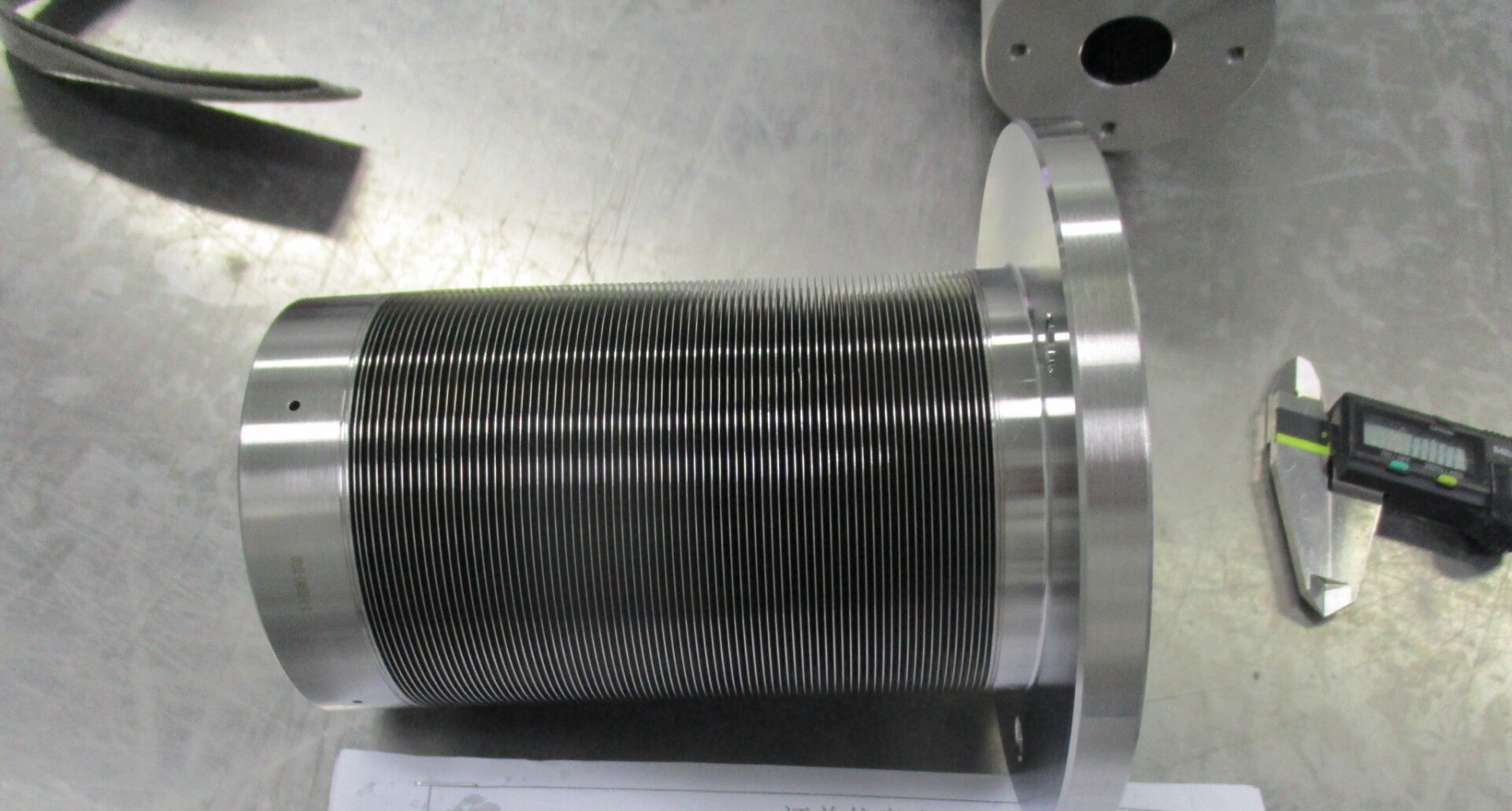
Liquid nitrogen flows through copper or aluminum shrouds lining the chamber walls, creating the cold black-body environment of space. The plumbing connecting those shrouds to the LN2 supply is a web of welded metal bellows, absorbing thermal contraction during every cooldown cycle — the same duty our cryogenic bellows guide documents for 4K-to-300K service.
Pumping and leak integrity
Large chambers use turbo pumps, cryopumps and diffusion pumps to reach high vacuum quickly, then maintain it for weeks of testing. Every port — electrical feedthroughs for instrument wiring, rotary feedthroughs for spin tables, viewports for cameras — must hold the envelope through hundreds of thermal cycles without leaking. The qualification is the same helium leak testing used across the vacuum industry.
Motion systems inside vacuum
Payload rotation tables, antenna deployment fixtures and sensor calibration stages move inside the chamber, driven through bellows-sealed or magnetically coupled feedthroughs — motion hardware that must operate at −160 °C without lubrication failure.
Why New Space Is Reshaping the Market
Constellation programs launch hundreds of satellites per year, and every one needs TVAC qualification. Legacy national labs cannot absorb the volume — which is exactly why commercial players like Resonate Testing and Angelantoni Test Technologies (ACS) are building regional capacity and modular chambers (ACS’s Qbe series targets micro and nanosatellites). For the vacuum supply chain, each new facility is a repeat order of chambers, shrouds, feedthroughs, bellows and formed bellows assemblies.
The Test Sequence Behind Every Launch
A typical TVAC campaign runs two to six weeks. The spacecraft is instrumented with thermocouples and power harnesses routed through electrical feedthroughs, then mounted on a vibration-isolated fixture inside the chamber. Engineers pump down to high vacuum, verify the leak-tight envelope, and begin thermal cycling: cold soaks at −160 °C with the shrouds at liquid nitrogen temperature, hot soaks at +120 °C using heater platens, and intermediate transitions that mirror the 90-minute orbit period. Throughout the campaign, pressure and contamination monitors track outgassing; mechanisms are cycled; RF and optical payloads are functionally tested. Any component that leaks, outgasses or mechanically drifts is found here, on the ground — which is why the test hardware itself must be as well-qualified as the satellite. The same discipline applies to the cryogenic plumbing: our cryogenic bellows guide documents the thermal-cycle testing that separates flight-grade hardware from laboratory fittings.
The Alpha Technology Angle
Alpha Technology manufactures edge welded bellows, vacuum feedthroughs and sealed assemblies for space qualification hardware — from chamber shrouds to the motion systems that test electric propulsion satellites. Our components are helium-leak-tested and documented for cryogenic cycling, bake-out and high-cycle motion. Contact our engineering team for TVAC chamber hardware.
FAQ
What is thermal vacuum (TVAC) testing?
TVAC testing places a satellite or payload inside a vacuum chamber with cryogenic walls, cycling it through flight temperatures to verify thermal control, outgassing and end-to-end function before launch.
How big is the TVAC chamber market?
Thermal vacuum space simulation chambers are projected to grow from $137 million (2025) to $199 million by 2032 at 5.5% CAGR, with some 2026 analyses citing up to 13.3% CAGR to 2033.
What vacuum components do TVAC chambers use?
Cryogenic shroud plumbing with welded bellows, turbo and cryopumps, electrical and rotary feedthroughs, viewports, and helium-leak-tested flanges and seals.
Why are bellows used in TVAC chambers?
Welded metal bellows absorb thermal contraction of cryogenic lines during every cooldown and isolate pump vibration, in service cycling from room temperature to −160 °C and below.
Building or upgrading a TVAC facility? Contact Alpha Technology for cryogenic bellows, feedthroughs and documented vacuum hardware.