
In March 2026, Microsoft and Quantinuum’s H2 system demonstrated 12 logical qubits at a logical-error rate of approximately 2 in 1,000 — a milestone that took quantum computing from “can we correct errors?” to “how fast can we scale the corrected machine?” Each logical qubit is a small army of physical qubits fighting noise; the noise they fight lives in temperature, electromagnetic interference, and contamination.
Here’s the engineering detail most quantum coverage skips: every superconducting quantum computer is a cryogenic vacuum system with a computer bolted on. The qubits live at roughly 15-20 millikelvin, inside a dilution refrigerator, inside a vacuum space that must be cleaner and quieter than a semiconductor cleanroom. As logical qubit counts climb, the cryostat and its vacuum infrastructure scale with them.
Inside the Dilution Refrigerator
A dilution refrigerator is a vertical stack of thermal stages, each colder than the last, with the qubit chip at the bottom. The whole stack sits inside a vacuum can — typically an aluminum or stainless vessel pumped to high vacuum (10-5 to 10-7 mbar) to eliminate gas conduction between stages. The vacuum can is the quiet, insulated box that makes 20 mK possible. Our earlier article on UHV components inside a dilution refrigerator walks through the system; this article focuses on what error-correction scale-up demands next.
Why More Logical Qubits Mean More Vacuum Hardware
1. Bigger cryostats, more penetrations
A 12-logical-qubit machine needs hundreds of physical qubits and thousands of control lines. Each control line — coaxial, DC, optical fiber — crosses the vacuum boundary through a feedthrough. The industry is moving from 100-line cryostats to 1,000-line cryostats, and every line is a potential leak path and a heat path. High-density vacuum feedthroughs with integrated thermal anchoring are becoming a standard building block.
2. Motion inside the cryostat
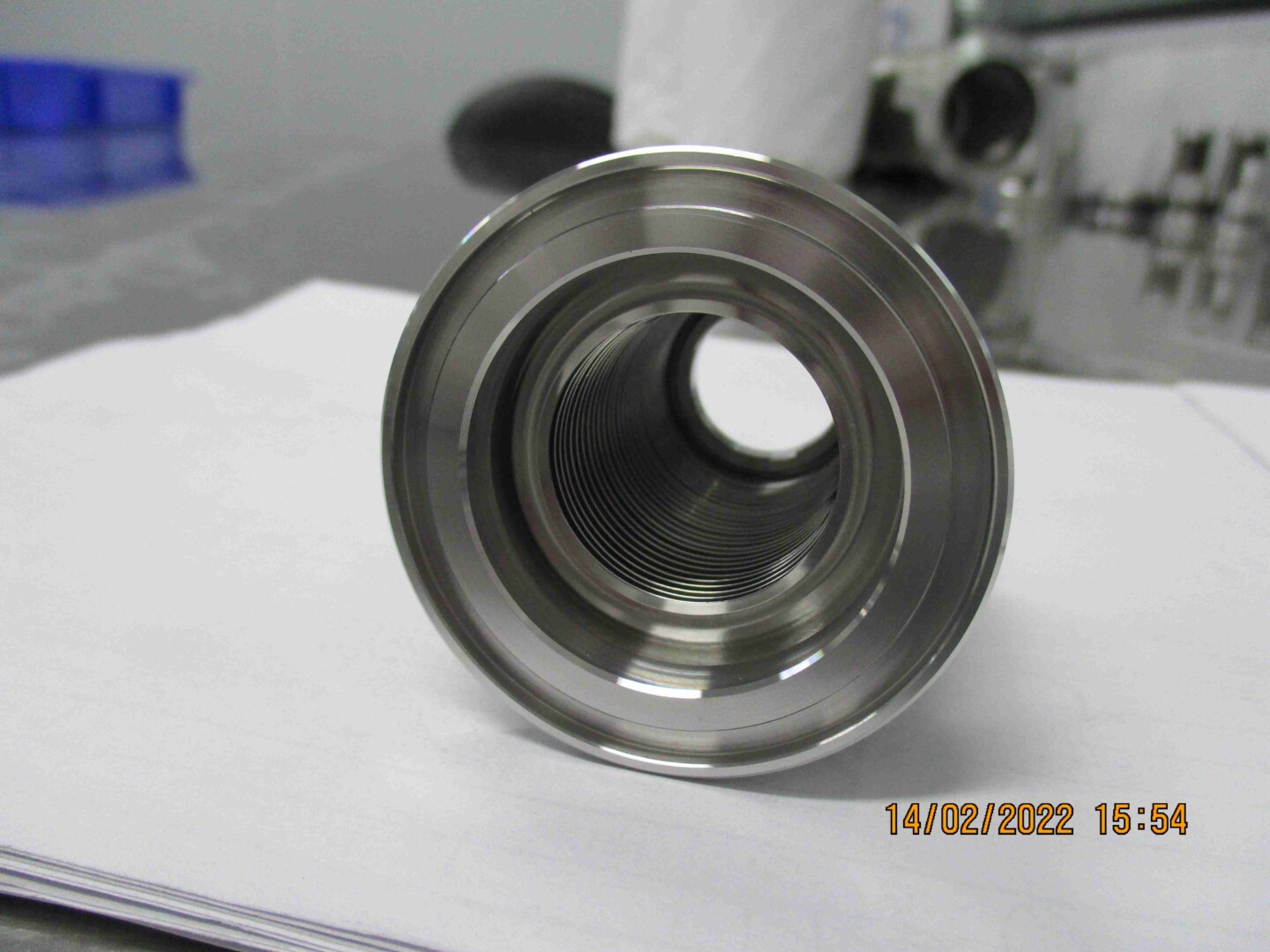
As machines grow, components inside the fridge need adjustment without breaking vacuum: tunable couplers, positioning stages for fiber coupling, and service mechanisms. Edge welded bellows provide sealed motion at cryogenic temperature — a capability we cover in depth in edge welded bellows in cryogenic service.
3. Vibration isolation
Mechanical vibration heats qubits and breaks coherence. Cryostats float on pneumatic isolators, but inside, pumps and motion mechanisms must be vibration-quiet. Bellows act as flexible, low-spring-rate isolation links between the fridge and the vacuum pumps — the same trick used in UHV research systems for decades.
4. Cleanliness at the mK scale
Any hydrocarbon that freezes onto a cold stage acts as a parasitic load; any particle that lands on a qubit degrades coherence. Components must be cleaned to semiconductor standards, vacuum-fired, and shipped sealed. This is the same cleanliness discipline we apply to semiconductor-grade edge welded bellows.
5. Thermal anchoring and heat load management
Every control line that enters the cryostat conducts heat from room temperature down to the mK stages. High-density feedthroughs must integrate thermal anchoring — braided straps, standoffs and careful routing that dump heat at each stage before it reaches the chip. For vacuum hardware suppliers, this means feedthroughs are no longer off-the-shelf pass-throughs; they are engineered thermal systems. The bellows that allow service access and vibration isolation add to the thermal design problem, which is why cryo-rated edge welded bellows with low conduction are designed as part of the whole cryostat, not bolted on at the end.
The Scale-Up Math
Fault-tolerant quantum computers are projected to need 1,000 to 1,000,000 logical qubits depending on the application and error budget. Even at the low end, a 1,000-logical-qubit machine means over a million physical qubits and tens of thousands of control lines — each with feedthroughs, cabling and thermal anchoring. The vacuum industry is not yet tooled for quantum at this volume, but the building blocks — leak-tested feedthroughs, cryo-rated bellows, ultra-clean assemblies — are exactly what Alpha Technology manufactures today.
Alpha Technology for Quantum Scale-Up
Alpha Technology supplies custom edge welded bellows, vacuum feedthroughs and welded assemblies for dilution refrigerators and quantum systems — built from 316L and titanium for cryogenic service, 100% helium leak tested, vacuum-fired and cleanroom packed. The material guide covers alloy selection at cryogenic temperature; the design guide covers motion and fatigue engineering. Contact our engineering team to discuss your cryostat’s next upgrade.
FAQ
Why do superconducting quantum computers need vacuum?
The qubit chip must be isolated from thermal and mechanical noise; the dilution refrigerator’s vacuum can removes gas conduction so the mK stages can reach and hold temperature.
What is a logical qubit?
A logical qubit is a fault-tolerant unit built from many physical qubits with error correction; Microsoft and Quantinuum demonstrated 12 logical qubits with an error rate near 0.2% in March 2026.
How does vacuum hardware scale with qubit count?
Each qubit needs control lines that cross the vacuum boundary; scaling to thousands of logical qubits means thousands of high-density feedthroughs, cryo-rated bellows and ultra-clean assemblies.
Can Alpha Technology support quantum cryostat qualification?
Yes — we provide leak test reports, vacuum-firing records and cleanroom packing, and can test components at cryogenic temperature on request.
Scaling your cryostat’s vacuum infrastructure? Contact Alpha Technology with your line count, temperature stages and leak requirements.